First assume that the 65 mil and 65 k are the amounts that each person has above what they truly need to survive. Like, above a living wage.
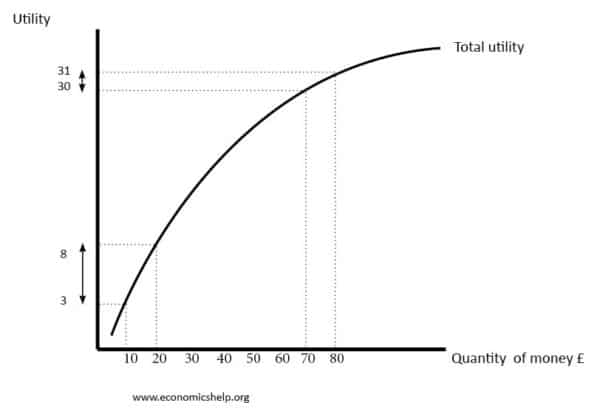
Economists often say the value of money is roughly logarithmic as it goes up, which would mean that both of those two people would lose exactly the same utility.
But this would imply otherwise. Does 17% of 65 million truly have less utility than 17% of 65k? (Some people would argue it has more.)
> Economists often say the value of money is roughly logarithmic as it goes up, which would mean that both of those two people would lose exactly the same utility.
Your conclusion contradicts the first part of your statement.
Here's a counter argument:
It probably depends on your aspirations. If you want to be a billionaire and you make $65k/year that $11k probably has low utility because you're so far from your goal and there are social and government safety nets to help you if you fall into poverty. But at $65M, that $11M might be one of only 3 or 4 shots you have at investing in a moonshot and making your $1B.
But, if your goal is to just feed yourself and vacation every once in a while than I could see how the value of money increases logarithmically.
If you view yourself as a company or an investor though, it might increase in value as you accumulate more because it puts you in an elite group that can invest in billion+ dollar ideas that could change the world.


If you fail, you'll have just one vacation house in Miami instead of two. I could live with that.