>"For example, trading in bitcoin is electronic, which facilitates competition and price transparency."
One of the main reasons this ETF was rejected is because many of the major exchanges like Bitfinex, BitMEX, Binance, and Kraken are alleged to be manipulators of spot price though wash trading, and front running their customers.
>"[23] Bitcoin are interchangeable, so that a purchaser is sure to get exactly the same thing no matter where she purchases it."
This is no longer true. Bitcoin transactions that have history tied to stolen funds, and illegal black market transactions will get your exchange account frozen and bank account flagged. ( see BTCe caught laundering MTGox funds https://www.theguardian.com/technology/2017/jul/27/russian-c... )
>[24] In addition, bitcoin mining is not geographically limited (except to the extent it migrates to places with cheap electricity), so it is not subject to geopolitical threats that plague other commodity markets.
This is a naive and incorrect risk assessment. Any large ISP is in a position to interfere, suppress, and drop traffic. Chinese based Bitmain, the largest BTC ASIC mining manufacture and the top known mining pools based in China are currently controlling over 40% of network block activity.
> One of the main reasons this ETF was rejected is because many of the major exchanges like Bitfinex, BitMEX, Binance, and Kraken are alleged to be manipulators
The fact that the price is being manipulated is indeed an issue, but the solution is not to reject the ETF but rather to implement an exchange that has proper audit mechanisms in place (as in: prevent wash trading that will make the SEC happy).
This concern was already the main factor that led to the previous rejection. Gemini seems to have worked hard to implement such audit mechanisms, but apparently still failed to meet the SEC's bar. That point was actually made in the dissenting opinion article.
The real question of course is if such an exchange, doing the right thing in a room full of offshore-based bad actors exchanges will actually manage to survive.
>>Bitcoin are interchangeable
> That is no longer true
Actually, that was never true.
Bitcoin's lack of fungibility has been a problem from day one, and to address it, half-baked measures have been tried (mixers), new protocols have been discussed and implemented (coinjoin, coinshuffle, bulletproofs, ... https://medium.com/@nopara73/tumblebit-vs-coinjoin-15e5a7d58... has a summary). The full solution is ZKP-based protocols as implemented by some alts {ZCash, Monero, ...}
However, I'm actually not sure that this is a problem when it comes to gaining SEC approval. The traceability of Bitcoin , which many see as a weakness of Bitcoin might end up being a very pleasing aspect for the regulator.
>This is a naive and incorrect risk assessment.
It's unclear what amount of correlation - if any at all - exists between miner control and BTC market price.
One thing that's always been true is that if a miner goes above 51% and starts to misbehave (as in, e.g. selectively mining transactions he likes, or more ham-fistedly, doing a 51% attack) this will deeply tank the price, and he'd be shooting himself in the foot.
In short, there is a built-in economic incentive feedback mechanism to "encourage" miners to behave, and that's a much stronger argument than the "geographically unlimited" one.
>It's unclear what amount of correlation - if any at all - exists between miner control..
Manipulation of arbitrage and suppression/prioritization of transactions.
This was demonstrated in an attack on the Ethereum network by the mining pool F2Pool, where a timed smart contract was manipulated by the mining pool to prioritize its own transaction and ignore other users transactions.
The issue seems to be "prevent fraudulent and manipulative acts and practices" in the spot markets.
Is stop hunting considered a manipulative practice? Because it's happening every day in bitcoin markets. But stop hunting also happens in the currency markets (which also have ETFs), albeit they are more sophisticated and tend to happen around news. I'm not talking about bucket shops, I'm talking about the real interbank market.
Bitcoin was increasing and possibly because of this ETF news and that Coinbase was considering adding more crytpos. It went up to $8507 then I saw news SEC is now taking its time on making a decision. From that day it’s been sliding back down.
> Cameron and Tyler Winklevoss won $65 million from the Facebook lawsuit, and invested $11 million of their payout into Bitcoin in 2013, amassing one of the largest portfolios of Bitcoin in the world — 1 percent of the entire currency’s dollar value equivalent, said the twins at the time. Their slice of the Bitcoin pie is now worth over $1 billion after Bitcoin surged past $10,000 last week to now trade at $11,100
A comment from 2013 on HN saying it's hilarious that savvy investors like the Winklevosses would put money in such an obvious ponzi:
> This is clearly illuminating the Ponzi-like elements of Bitcoin. As in a Ponzi scheme, early arrivals to the system earn easy money, funded by later arrivals. Tales of bitcoin fortunes draw more and more entry to the system, leading to large payoffs for second stage arrivals, attracting more speculators due to the media attention and very real money that has been made by early players. This continues until, oh, wait, bitcoins aren't so easy to mine anymore and there's no new wave of incoming money to pay of the next generation of miners.
> The hilarious thing is that Bitcoin is quite transparent about exactly how it works, while a real Ponzi scheme goes to great lengths to hide this dynamic. Anyone can see this dynamic in the rising price and the increasing CPU time needed to mine a new coin. And yet, brilliant, savvy investors like the Winklevosses are somehow still getting involved...
I'd be so tempted to take my $32.5M and retire for life. Pretty gutsy to invest 17% of your wealth in a single early stage technology when they did. I guess retiring on $27M instead wouldn't be so bad either though if it bombs.
First assume that the 65 mil and 65 k are the amounts that each person has above what they truly need to survive. Like, above a living wage.
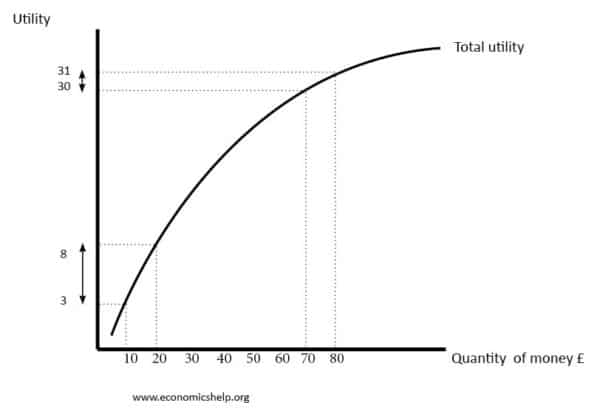
Economists often say the value of money is roughly logarithmic as it goes up, which would mean that both of those two people would lose exactly the same utility.
But this would imply otherwise. Does 17% of 65 million truly have less utility than 17% of 65k? (Some people would argue it has more.)
> Economists often say the value of money is roughly logarithmic as it goes up, which would mean that both of those two people would lose exactly the same utility.
Your conclusion contradicts the first part of your statement.
Here's a counter argument:
It probably depends on your aspirations. If you want to be a billionaire and you make $65k/year that $11k probably has low utility because you're so far from your goal and there are social and government safety nets to help you if you fall into poverty. But at $65M, that $11M might be one of only 3 or 4 shots you have at investing in a moonshot and making your $1B.
But, if your goal is to just feed yourself and vacation every once in a while than I could see how the value of money increases logarithmically.
If you view yourself as a company or an investor though, it might increase in value as you accumulate more because it puts you in an elite group that can invest in billion+ dollar ideas that could change the world.


Within the SEC, there are dissenting voices:
https://www.sec.gov/news/public-statement/peirce-dissent-34-...