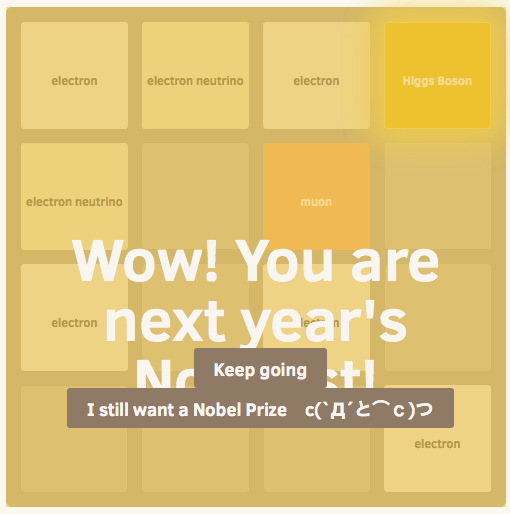
This would been cooler if it actually followed physics in some way other than simply using physics terms. Combining 2 gluons makes a proton? This variant is just nonsensical.
As others have said this game has nothing to do with physics except for the names of the tiles.
If the progression followed particle masses it would make a tiny bit more sense but it doesn't. The neutrinos for example, are much lighter than their counterparts. I guess that masses would not make sense to use since the Higgs boson is not the heaviest known particle at 125 GeV, that distinction goes to the top quark at 173 GeV.
A more realistic game based 2048 and physics might be hard to make. Colliding particles does not work according to some recipe like: electron+positron makes a muon or something like that.
Instead there are a large number of possible recipes(Feynman diagrams) for every collision. In fact we have can have any reaction that is allowed as long as you conserve energy, momentum, angular momentum, electric charge and a few other exotic quantities. Each of these reactions can be assigned a probability and you cannot know beforehand what the outcome of a certain reaction will be. Adapting this into a 2048-style game is not obvious.
A game that would actually work is adding up neutrons and protons into atomic nuclei. Having a nucleus with 2048 nucleons is of course not very realistic but if you add in the decay of unstable isotopes only reaching Uranium-238 may be hard enough.
Now, could someone make recursive 2048, where the tiles are instances of 2048 game and the whole thing loops on itself, the top game being also the bottom one in one branch of a tree?
And each move you make in the meta-game releases the same move in to each of the tiles. "Game over" blocks could either end the game or be merged into something scarier.
I actually think this is quite clever. It's not a tech improvement but its a domain shift that fits well. I took something from it, in a different way than other clones did.
That wouldn't make much sense, seeing as these combinations aren't physically accurate. You don't make an electron neutrino by combining two electrons, for example.