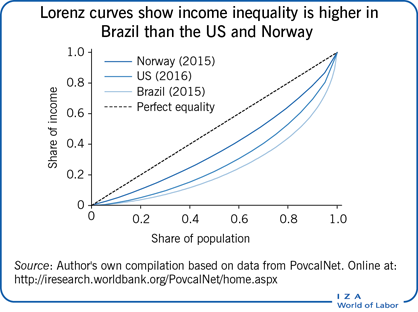
It's a curve reflecting income (not wealth) share of a population against a line of perfect equality, which is a 45 degree angle. A low disparity hugs the line and a high disparity hugs the X and Y axis. Gini = A/(A + B) where A is area over the curve and B is the area under the curve. So an increase of 0.1 in the gini number reflects a larger A.
It's not a very good way to measure what it is trying to measure[1].
I think the main problem is the lack of intuition of what "1 Gini means", except the "lower is better". Is difference between coefficient of 10 & 11 the same as difference between 30 and 31? The poster to which I responded said that "32 vs 41 is not far apart" - is it? Is difference between 10 and 19 the same as difference between 32 and 41 (delta is the same)? How about between 0 and 9?
That was me, and they aren't that far apart. Is 41% of the area under a lot more than 32%? Not really, see this example[1] Norway here has a coefficient of 27.5 and the US was at 41.2 but the graphs are barely different except that you can see that the US has a sharp bend on the far right hand side. The gini formula is really sensitive to that in a way that doesn't tell us much.


It's not a very good way to measure what it is trying to measure[1].
[1] https://en.wikipedia.org/wiki/Gini_coefficient#Limitations