I don't think this attitude is helpful - it's going to leak out in your interactions and poison relationships.
You do need to consider the context and background of a person before you can properly understand or trust their opinions and advice. For example, a physicist may be ignorant of how car engines actually work; a mechanic may be ignorant of some of the underlying physics. You really need to get to know people and build a long term relationship to understand if their opinions on a topic are useful and informed.
I don't think there is a simple rule to working with other people - you just need to build a wide body of experiences yourself, and beware of relationships that grow too quickly or where the other person appears to have a hidden agenda.
Yes applying and practicing the assumption that people are lazy, stupid and insane, does active damage to conversation.
The article is actively unhelpful, possibly doing harm. The section titled “What can you do to take advantage” answers it’s question with ‘Nothing, but it makes you feel good.’ That’s a pretty lazy take, and IMO pretty lazy writing. There are ways to take advantage of the negative sides of human nature, and we collectively agree they’re bad for us and sometimes should be illegal.
A friend once told me some advice that is a simple rule and can often do wonders in personal conversations, and even when commenting here on Hacker News. He said, “no matter what conclusions your brain tries to jump to about someone, always assume people have something brilliant to offer and that they are amazing in some way. Try to find it.” The article doesn’t disagree, but ironically chooses to focus on the worst. I can confirm from experience that this approach of assuming the best will statistically more often help you win friends and influence people, and that assuming the worst about people will not.
When building a product, it sure helps to not assume anyone's intelligence. Even better, assuming everyone is insane helps you consider more cases where user behavior could cause an issue. Ultimately, that saves time.
FWIW, I took my friend’s advice all the way through founding a company and building a product. I disagree about assuming everyone is insane for building a product. The more helpful way to approach this is that everyone has legitimate needs and hopes for your software, but that they are overwhelmingly different from each other. Your job is to translate and prioritize the many legitimate wishes and expectations into something that will maximize the number of people you serve.
Assuming your customers are not intelligent or that they are insane is going to prevent you from being able to empathize with what they think they want, and it’s going to make it harder for you to translate what they want into features you should build. The assume-the-worst approach can also make you come off as tone-deaf, if you never accept and never understand what people are asking for.
Assuming that user behavior can cause certain issues is a valuable angle to consider, I agree with you there, but that viewpoint needs to feed back into the product as a question about whether you actually designed your product for people who don’t know how your product was built. If the product is fine, then it needs to question whether you have sufficient training of your product. Ultimately, it needs to question your assumptions, not your customers. Assuming people are insane is going to act as a force against understanding why your product isn’t perfect.
Arguably both of the viewpoints are correct and market goes into different swings depending on where you are in history. What if we are at the cusp of the swing back to high customised products after Apple and Google had been pushing highly top-down non-customer-oriented products-that-think-for-you upon us for at least a decade now?
(Sorry for the long post, I’m trying to explain but editing lazily. It’d be more concise if I had more time.)
I’m not sure, what are you suggesting that it changes if apps become more customized or more customer oriented? Wouldn’t that only make understanding the users’ expectations and not writing them off as ridiculous even more important?
I’m not entirely sure what you mean, like why the state of design of Google or Apple apps has much bearing on how to approach what you assume about customers - apart from the fact that it’s really helpful to understand the ecosystem of software and the UX elements that people have become accustomed to. Yes it’s harder to design phone apps that behave in fundamentally different ways or using fundamentally different interaction models than what people are used to. You might understand your idea is superior to what Google did, but when people reject it, that doesn’t mean people are insane, it means the opposite, that there’s a good reason for their expectations and that you and I might be insane for trying to fight the tide.
I’m also not sure what it means to be “correct” about assuming people are insane. But to be clear, my argument is not that it’s incorrect, my argument is that it’s not helpful or constructive, and it can prevent you from self-reflection or improvement in a harmful way. Assuming people are insane is to reject a reasonable explanation, it’s a very (ironically) lazy way to rationalize not trying to understand.
Under normal circumstances, with average people, people have expectations that are completely reasonable and come from a history of their experiences. If you assume they’re insane, what you’re really doing is willfully closing your own eyes to their context and shutting yourself off from seeking out what they want.
It’s important to realize that people doing wacky things with your product is a result of differing expectations, and explore the sources of this discrepancy. Inside the gap there are a variety of reasons that include failure of the app builder to clearly state their expectations. If too many people are doing seemingly silly things, it might mean you haven’t made clear who your app is really for, and what it can or can’t do. Assuming you’ve done everything you can do, explained everything about your product clearly, assuming that it can’t be improved and that someone using it wrong is just crazy, that’s a pretty bad assumption and rarely if ever “correct”.
> I don't think this attitude is helpful - it's going to leak out in your interactions and poison relationships.
Strongly agree. Keeping ourselves humble and remembering that nobody is infallible is important.
However, taking it to the extremes this article suggests (“Everyone is stupid”) is exactly the mindset that leads people to ignore experts, discount research, and promote their own feelings above the science.
The mindset is great for an ego boost because it’s an easy way to take everyone else down a notch and make everyone feel more or less equal. But when it comes to individual topics, everyone is definitely not equally informed. Pretending they are is a mistake.
The real skill is learning to identify who to trust and who to dismiss. It’s easy to mistake confidence and slick presentation or even angry contrarianism for being right these days, but learning how to look past that is very important. Putting blinders on and telling yourself that “everyone is stupid” is not a good way to do it.
> Strongly agree. Keeping ourselves humble and remembering that nobody is infallible is important.
That's not how it works in real life from my experience.
I usually assume everyone is stupid, including myself, that's the most humble thing a person can do IMO.
But what actually happens is that other people assume that I am the only one who's stupid, because I'm open about the possibility, while they don't even consider it a thing.
It's a well known human bias, there's almost nothing we can do about it, except train or minds to see others and ourselves as fallible, instead of victims of the system.
> it's going to leak out in your interactions and poison relationships
As a continuous attitude, agree this advice is toxic. As a temporary place you take yourself to stress test plans, it’s valuable. (I’d add: people are assholes. How will a self-serving, morally unconstrained actor run roughshod over the assumptions your system makes?)
I think it can work when thinking about accountability and checks-and-balances in processes and roles; for example how would I detect if my CFO is stealing money from a startup, or what if a narcissist became a manager at my company? But I would apply in on a role/position level, not as a starting assumption in new relationships.
> I would apply in on a role/position level, not as a starting assumption in new relationships
Agree. My doublethink fix is to ask what could go wrong if the person in front of me were replaced by a dishonest, incompetent, narcissistic and/or venal one.
"Rational founder" is a contradiction, at least if you believe that a rational actor maximizes the expected value of their life. The modern rational actor pursues the low-risk, high reward professions in finance, law, and medicine if you have good grades and access to capital, and regular entrepreneurship (e.g. start a plumbing business) if you don't. (And if you're a child of the .01%, you're rich no matter what you do, and heaven help you and your character survive the damage that will cause you!)
To believe that starting a new business on the internet is a path to riches is irrational, similar to believing that buying a lottery ticket will lead to wealth. However, it IS a path to valuable pain, learning, and again, with luck, wisdom. The riches are optional, unlikely, and probably means something a lot different once you get them, because by that time you've probably come to appreciate the striving for it's own sake.
Which level of 'riches' are we talking about though? If you're not aiming for a unicorn then the goal of a small, sustainable internet business is much more reasonable. Your main problem at that point becomes your competitors growing faster and smothering you out of the market.
Do a lot of people start internet businesses aiming for a small sustainable lifestyle business? I personally think that's a very healthy place to end-up, but I suspect that a lot of ambitious people would consider it a kind of consolation prize. You are not, in that mode, "changing the world". (But then, as we have learned over the last 25 years, changing the world with the internet isn't exactly without downside!)
"To believe that starting a new business on the internet is a path to riches is irrational"
Why? There are plenty of examples of smart, educated people having success on the internet, so it is rational to see this as a path to riches, if you are smart, too. Of course the assumption, that you yourself are smart, might be wrong. As might other delusional expectations. But copying what lead to success for others in similar situations is a very rational, I would say evolutionary concept.
Yes, because lottery is random and unrelated to skill, unlike starting a buissness.
So there surely is no guarantee for anything, as your assumptions about some market for example might be wrong - but again, making right assumptions is related to being smart.
Picking the right numbers is related to chance and unless you believe in magic, you cannot influence your chances.
> a rational actor maximizes the expected value of their life
If the definition of human value is "money" then you're probably right. But I would question whether someone who has the drive to found some new venture, but never does, has really maximized their personal value.
That depends upon a person's values. People do not only start businesses and organizations just to get rich. Although that is certainly a common reason among founders, along with other reasons.
My manta is almost the opposite. Every morning I write and and say to myself, "Love others. Be kind. Imagine people complexly."
My default is to assume everyone else is a dumbass with bad intentions. The vast vast majority of the time they are not. They either live a life that led them to believe some ideas contrary to my own and/or are trying to get some goal of their own finished and I am just a background character in their story.
I don't know if I would say most people are good people but most people are not actively trying to be bad people.
I don’t think the article suggests the need to assume malevolence. One can assume everyone including oneself of being mentally flawed without being morally flawed.
1) Most people are unaware of the conflict between benevolence and other values. Conservation and Self-enhancement are common focuses used as justification for behavior that is malevolent and not benevolent.
2) Relative
3) "Most value systems are equally valid." False. Human caste systems (including the current american caste system) are created, justified, and enabled from a variety of value systems.
Why would most value system be equally valid? What mechanism would cause that to be the case? What do we mean by "valid"? Are they equally "Good" in some sense, is that different than valid? Some people have value systems where women should be killed if they are raped because they bring shame on the family, is that equally valid?
I believe OP is implicitly saying "Most value systems [held by people you interact with on a daily basis] are equally valid". That's very different from the set of all conceivable value systems, and it's a lot easier to imagine the mechanisms by which the limited case holds (i.e.: people are pretty good at selecting valid value systems).
Maybe I'm jaded and cynical, but in our current political climate, I don't believe these.
> 1) most people are kind and want to help others
Most people would CLAIM to want to help others, but there are a lot of people that say they don't want socialized healthcare and frame it as being against their tax dollars being spent to treat a smoker's lung cancer or an over-eater's diabetes. The fact that it could also save people from health problems that are no fault of their own isn't important.
> 2) most people are not experts in most things, but do know a lot about a few things.
They know they're not experts, but they claim to be. Not hard to find immunologists who earned their degrees from social media that think that vaccinated people somehow shed the COVID virus and actually increase the spread.
> 3) most people have different values which comes through in their priorities. Most value systems are equally valid.
The first part of this is absolutely true. Just look at "socially liberal, but fiscally conservative" people that will happily throw their values regarding minority issues into the garbage in favor of a tax break they probably won't even see because they don't earn enough.
Whether all value systems are "valid" I guess depends on your definition of "valid".
1) In a socialized health care the tax dollars will be absolutely spent to treat smoker's lung or an over-eater's diabetes. There will be no money left to save people from health problems that aren't fault of their own. Only people rich enough will be able to bribe their way to the appropriate treatment.
2) Everyone has a right to their opinion, social media is a collection of people and their opinions, not medical journal.
3) Tax breaks are for the minority, the rich people, give tax breaks to everyone. Yes, value systems are subjective, deal with it.
> When I think of smart people—like really smart people, not just the smartest guy on the bus, but theoretical-physicist-smart—I can only conclude I’m a damn idiot
What if you have the upper hand and are emotionally intelligent, while lacking academically or in other areas? There's different types of intelligence, like for example being smart about your own body, or being both mentally and physically fit, ready to take on whatever life throws at you.
Maybe some smart physicists are secretly depressed? Maybe they're a bit eccentric and not good in social situations where they're afraid to be their unstable selves. It's all about context and perspective.
Ha! IAATP (I am a theoretical physicist). We're nothing special. Your comment is spot on. I'm not that smart, I just think of the world in a different way. No matter what I'm looking at, I view the world as a set of coupled differential equations. That's great for understanding how a pandemic works, but not so good at connecting with your neighbor over a beer.
We all have our strengths and weaknesses and you should never think of yourself as less-than because someone else is better than you at something. You know what I can't do? Pass a FAANG interview. I've tried! 3 times! I write novel algorithms to handle complex data and do numerically accurate high-level math. Yes, I can even balance a binary tree (I had to do that to manage a list of basis functions), but I think about computing in a way that makes the people think I'm an idiot when I'm standing at a whiteboard.
So I could say that all of those FAANG folks are smarter than me, but they're not. They just have different skills than me.
The only person to compare yourself to is you from yesterday. And as long as you're making progress (on even just one dimension), consider it a success.
Physics isn't some black magic art. Yes it takes time and understanding that I will personally never have, but it's not the unobtanium people think that it is. Most of the reason people leave theoretical physics is lack of jobs and resources at the lower rungs.
You can be "theoretical physicist smart" without being a theoretical physicist.
How is "being both mentally and physically fit" a form of intelligence? Not to say it's not important, or something to work toward, but let's not turn this into some weird participation trophy "everybody is smart in their own way" nonsense. Having clinical depression doesn't make you more or less intelligent. Being socially awkward doesn't change your intelligence. Conflating EQ as a different "kind" of intelligence is silly.
Regarding "being both mentally and physically fit", while I agree that it's not intelligence on its own, I think this is a good description of the biggest source of variance in the intelligence I can apply to a task at any given time.
I'm way smarter when I'm well-rested, well-fed, being active, etc.
You’re diving head-first into the philosophical question of what “intelligence” means, but arguing without defining it yourself. You could offer your definition if you want. You could also allow for and acknowledge that there are people who define the word differently than you, right?
Since your comment is hinting at this underlying implication, one question to answer up front is why you want to rule out factors that will improve your odds of a better outcome. Why are you resisting wisdom and emotional ability as a factor of intelligence? If people can accurately pattern match their historical lessons and/or emotions and apply it effectively to situations, that is a form of intelligence, no?
> How is “being both mentally and physically fit” a form of intelligence?
Despite people’s attempts to measure pure smartness potential, learning and education increases intelligence on every metric we have today.
Studies have also shown that exercise has a meaningful impact on intelligence, and that it can be used to treat depression.
I’d agree that being socially awkward doesn’t change your intelligence, but it can affect people’s perception of your intelligence and feed back into your motivations and actions in a negative way. Anyway, social awkwardness is something one can fix with learning and practice.
> Conflating EQ as a different “kind” of intelligence is silly.
I wish I remembered the name of the astrophysicist in the early 20th century who made a correct conclusion but who was ignored because they were so generally disagreeable. It wasn't until at least a decade later that others reached the right conclusion.
The terms lazy, stupid, etc. are relative terms, relative to expectations.
"Everyone sucks" is, generally, disillusionment talking. Rational embellishments like this author is indulging in often follow.
People are people. Both irrational and rational, lazy and industrious depending on the scale, circumstance and expectations. In any case, we usually present and pretend to be better than we are. I think that's where a lot of the disillusionment comes from.
> You’re almost certainly worse at understanding your own biases than you are at recognizing them in others
Understanding how projection works is the best method I've found for self-critique. Once you realize that people often accuse others of what the accuser themself is guilty of, you can then group yourself with "people". There's nothing nefarious about it; you're just apt to project your own way of thinking on others.
I've been reading "Mistakes Were Made (but not by me)" by Carol Tavris and Elliot Aronson. My daughter recommended it to me and I finally got around to reading it. The main thesis is that everyone is prone to self-justification, which is an umbrella under which one finds motivated reasoning, projection, and so forth. It belabors its points a bit, but it's a good read, and seems relevant to this thread.
It's been my experience that by large people tend to do what you expect them to do. Sadly that is not always what you want them to do...
While I'm aware that most of our motivators are not rational, I am not going to poison my mind with expectations of "stupid, lazy, and insane behavior". The confirmation bias that would lead to sounds utterly depressing.
Not sure why article needs to redefine what is decades old knowledge - 'successful psychopaths' are what others call 'highly functioning sociopaths'. Take ie any corporation old enough, and its top (and often middle) layer is composed almost entirely of them. They sure can talk nice especially on camera, but they are ruthless inside and not somebody you can have as true friend. Its a spectrum which gives certain bonuses is used right (or destroys life/lives if not).
One needs to be an exceptional leader, smart, hardworking and other virtues to thrive in such an environment if not having this trait. And play politics hard. Now why would somebody so talented cause it to themselves, when starting a company these days might be a much better idea.
Its so frequent I would claim its coming from who we are as humans, I presume similar things were to be found in medieval kingdoms and earlier too.
I don't see it inherently as necessary evil, as long as these people have the right carrot at the end of their stick and not just power for the power itself or some messed up kicks from being on top regardless of the collateral damage. The reason is, these people often tend to deliver and deliver way more than average. Steve Jobs was one. Gates is another. Bezos too. And many others.
Old kingdoms are basically modern companies in many ways.
Just to be clear I am not saying it's necessarily a bad thing - nowadays you can start a new kingdom any time you want and don't need God to be your ancestor.
I just started Graeber's posthumous work, "Dawn of everything". Near the beginning, he compares the debate over whether humans are fundamentally good or evil as akin to a debate over whether humans are fundamentally fat or thin.
But then he goes on to say that these reductive simplifications that have been made about the nature of man, whether by Rousseau or Hobbes, are still useful because they take you down a line of thinking, and help you start a sketch of people. Afterward, you can fill in the details.
I think articles like this are similar. Its obviously not correct. But people are nonetheless always making attribution errors - we assume our mistakes are because of circumstance (I didn't see him in my blindspot!) and other people make mistakes because of their disposition (he cut me off - what an asshole!). So its a useful reminder, despite its fundamental inaccuracy.
Having recently watched this video on Bonhoeffer‘s Theory of Stupidity, https://www.youtube.com/watch?v=ww47bR86wSc , it seems that "stupidity" is a result of intellectual laziness.
However, we only have so much mental energy dedicated to truly try to understand those forces that affect our lives. Sometimes spending too much time analyzing can lead to its own form of insanity (https://thekingandid.wordpress.com/2018/08/12/chesterton-on-...).
Realizing that over-thinking can lead to issues, justifies anti-intellectualism and intellectual laziness. Repeat...
This doesn't track, imo. What helps me through life is managing my expectations of people and raising the bar when I chose to. In the beginning I set pretty low expectations for people. Some people may exceed those expectations consistently, but that doesn't mean that I want them to, or that at higher expectations they'd be nearly as consistent. Some people will eventually supercede expectations, but they must be met with a challenge to do so. Managing my bar gives me freedom from disappointment in a way.
The great thing about us is that we are predictably irrational.
Our quirk or pattern is that we use shortcuts (biases, heuristics, habits) most of the time, not because we are stupid, lazy or insane, but because they work or used to work most of the time, especially in familiar situations. Shortcuts are used to economize on our time, attention and energy, and they are vital when there is too much information, not enough meaning, when we need to act fast or decide what to remember.
Another of our quirk is that we constantly try to hide from and fix reality. Reality is beyond our control, it is complex, random and unfair. It isn't designed to maximize our potential or make us happy, therefore we treat it as if being broken.
We always try to fit everything into a coherent pattern. If the information spoils the pattern, we reject it. Having less information can make it even easier to fit everything. We want to be dogmatic and find that one right answer and settle on it. If something is easy it feels true, it feels valid. The problem is that as our access to data as evolved, our brains haven't.
We are generally blind to all of this, and we generally struggle to turn our intentions into actions. We are limited, we're of two minds (reactive and deliberative thinking), we use shortcuts, we're deeply affected by context, but what do you expect from a jelly-like three-pound mass of tissue. It also got less efficient as it evolved, as we started to become a civilization. You don't need a big brain if you can use everyone else's.
Oh I already do assume that! That's why I have such an overflowing social life with lots of mutually fulfilling relationships! /s
Sadly I've come to much the same conclusion as this article. Nobody has any idea what the fuck they're doing, especially the people who think they do. I certainly don't know wtf I'm doing.
Me: Stupid? Probably not quite, at least in most ways. Lazy? Guilty. Possibly insane? Remove the "possibly".
When I worked for the navy the adage about navel engineering was "designed by Geniuses to be used by idiots (i.e., Navy cadets) "
When I worked for the space program, whenever we came to complicated procedures or rules to follow the adage was "our users are rocket scientists or astronauts -their smart enough to handle this 20 page procedure"
Which adage works best for dealing with how your audience uses your software or your processes? should you consider them to be geniuses or idiots?
In general We tend to ignore the cognitive load that our work can impose on a busy person, as engineers our processes and tools usually require extra cognitive effort to learn that is usually an added burden on the user. It never hurts to make things simpler but it does take a lot of design effort to do so -but the value gained (in efficiency, time savings, and lack of human errors getting introduced into the system) is usually additive, even if that user is an astronaut or a lowly cadet...
- I think the article is basically reframing Hanlon's razor: "never ascribe to malice that which is adequately explained by incompetence.."
Maybe another way to approach this would be to do away with certain value-loaded terms and talk instead about how all human behavior is best explained by a complex, partially understood, but limited set of spectrums that will inevitably prove maladaptive to many sets of circumstances in a way that might seem "obvious" to most everyone else.
I think there's lots of value in using provocative terms to make that point. If we can accept that everyone really is "stupid, lazy, and insane" I think that should end up robbing those words of their sting. It should prime us to be more compassionate and patient with others and ourselves, not less.
I also don't think we can get away from the fundamentally disappointing nature of this without making a totally separate point. It's probably true that any given person is also predisposed to be very well adjusted to many sets of circumstances (i.e. to be kind, brave, and pretty damn clever in their own way etc.), but that's clearly not a guarantee in the same way.
I assume that most people aren't exactly rational, but the difference between a normal person and a weirdo is that normal people know how leave bad situations.
It's okay to go to a store, and get visibly upset when they're all out of the toothpaste that you want. It's not okay to start berating the minimum wage employees over a lack of toothpaste.
What I've seen a lot in outrage or YouTube culture are people who will record themselves being jerks. One video which made me puke, involved a couple who would run around and sticking their hands in people's food. Consequences aside, stop it.
If your arguing about a late rental fee, walk out. You don't refuse to leave and get the cops called on you. You don't then post videos to YouTube where you're essentially bragging about being unable to pay your rent on time.
The comments here are great! I think a key point here is understand that everyone we work with and are around fight these types of urges just as we do. So by understanding that we all fight laziness and we all fight irrational thoughts on some level few provides huge benefit to us and leadership
That is what I missed after lurking on HN for so long since it's inception: the willingness to read comments, however good or bad (and articulate) they are.
This may seem unrelated but I think a lot of our abilities are unconscious and we tend to see things in hindsight to explain why we behaved as we did, trying to rationalize things and believing in our explanations even if they make no sense. I noticed playing Beat Saber in VR in the beginning I sucked. I went from thinking about what to do in beginner mode making a lot of errors then much later just automatically doing very complex movements effortlessly in expert+ mode over the pandemic. I didn't have to think. Maybe most of our lives are on autopilot so we are dumb in that sense of not being aware. I feel similar with driving, walking, typing, etc... so many behaviors seem like this...but oddly enough, that seems to be the key to actually performing effectively.
iirc There is research with brain scans showing that in some scenarios people take an action first and then come up with reasons why after. Anyone remember details enough to find the source?
Related to what you're after, people prepare movement before they consciously decide to act. I read about this in "The User Illusion" by Tor Nørretranders. He cites Deecke, L., Grözinger, B. & Kornhuber, H.H. Voluntary finger movement in man: Cerebral potentials and theory. Biol. Cybernetics 23, 99–119 (1976).
This is a very unintelligent world view, and it leads to disastrous consequence.
If you do not understand why someone believes what they do, or why they take the actions they do, it is easy to just assume they are stupid or irrational. But that prediction can not be disproven. No matter how many times you see that same person acting intelligently and rationally, that could simply be the stopped clock being right twice a day. And we very much desire for those people we don't understand to be stupid or irrational, as it means we do not need to reconsider our own assumptions, and can safely feel smugly superior to those simpletons. Of course when our assumption is incorrect, we do not even realize that we are in error and just keep going through life blissfully unaware of our ignorance.
On the other hand, if we assume that this person who has spent a lifetime developing a unique worldview knows something we don't, then we must spend great effort trying to see the world from their perspective to try and figure out what we're missing. We may, after extensive searching, find that there really was no missing piece, that the other person actually is stupid and irrational, but still we will come out ahead for having learned more about the world. It's also possible, and indeed far more common, that the person is not stupid but still holds incorrect beliefs because of a specific and identifiable issue with their prior learning, which can help us to better understand how to properly communicate with those people.
And indeed, if you do go through life with the latter viewpoint, you find that people knew something you didn't nearly every time. Perhaps I have merely been particularly blessed in my acquaintances, but I'd estimate I've met less than 100 genuinely stupid or irrational people over the course of my life, a tiny fraction of the total. In general, I simply knew less about a topic than I thought I did, or there is some seemingly intuitive but ultimately wrong idea that is widely believed. I've yet to meet an intelligent person who simply assumed everyone else to be stupid and irrational.
The article is way overbearing; but one part I do like is applying to myself with regards to my computing environment. I think I came at it at first with this idea of "I'm pretty smart, and if I add some of my smart to the computer I'll be even smarter..."
And along the way I've come to realize how important "habit" is. Now, I implement little bash scripts and prompts that speak to "me at my most tired/dumbest/laziest" etc, and it's been phenomenally helpful. Little things that people might be embarrassed about, etc al.
Literally the opposite of my world view. With exceptions of things like bad motorcycle accidents without a helmet. Virtually everyone you meet is smart. It's just what are they smart in? Jeremy Clarkson officially knows far more about industrial farming than I do, but I know much more about IT in general. We both probably know nothing about aviation engineering.
When you start treating people as such, it becomes a very enjoyable game to learn more about people and find the periphery of your shared venn diagram of knowledge.
I've got the same world view. I haven't actually met anyone truly stupid. At worst I've met people who have some sort of cognitive disorder or straight up brain damage from some sort of trauma.
However, I have met people who some people might call 'stupid'. So far it seems that what's actually going on is that those people were stuck in some sort of situation where they had to learn to act in a certain way to handle it. For example, if your parents are abusive narcissists, then you might end up having trouble dealing with the real world. It's not stupid, it's maladaptive. And it's what you needed to survive a bad situation.
Ya, absolutely agreed. This is the only way to have meaningful conversations and build relationships I think. Even if someone doesn't understand something, it could be random ignorance or not their specialty.
I think another way to put it, would be to assume that any given person knows more than you, or more than you think they might, and to approach every situation with humility.
I also share the same world view. With every person that I met, it was just a question of finding what area/subject they spend a lot of time doing. They will be more knowledgeable on it than you, and by accepting it and listen to their expertise you'll learn a lot about some subjects you didn't even know existed.
I don't think that's at all in conflict with the point of the article. Like you said, virtually everyone you meet has knowledge outside of your shared diagram, so it's not unreasonable to think some of that knowledge could be relatively commonplace.
If you extend that same humility to others (rather than unfairly assuming that you're just especially naive) then you're really coming to the same conclusion as the headline here in a more diplomatic way.
Most people have a mental map of the world (except for packers, those people are just plain weird) Assuming that anyone else has the exact same map is foolhardy at best.
Most people have things they need to get done, if your tool can help, great! Don't expect them to think of it in the same way you do. Sometimes there is a misunderstanding that discovers something even more useful than intended. Be open to those bits of serendipity.
Yep, I have been thinking that human behavior seems rational in hindsight because darwinism is rational. The most rewarding actions result in better survival of the actor and their ideas. Even if everyone acts completely randomly, rationalism wins because of darwinism. We don't actually need rational actors for game theory to work.
Okay. I get it. Clickbait title. The argument they make for redefining stupid and lazy is okay.
They don’t define insanity other than a vague reference to half of the people in the world having a mental illness. And then they immediately proceed to only mention psychopaths having a lack of empathy.
It’s kind of ironic that the article embodies most of the flaws listed in it.


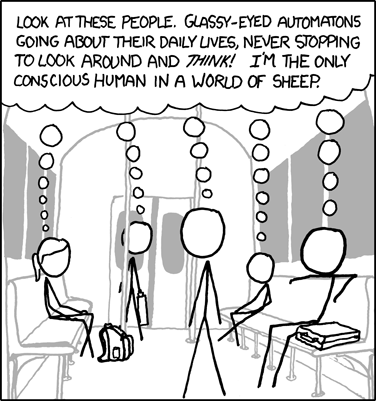
You do need to consider the context and background of a person before you can properly understand or trust their opinions and advice. For example, a physicist may be ignorant of how car engines actually work; a mechanic may be ignorant of some of the underlying physics. You really need to get to know people and build a long term relationship to understand if their opinions on a topic are useful and informed.
I don't think there is a simple rule to working with other people - you just need to build a wide body of experiences yourself, and beware of relationships that grow too quickly or where the other person appears to have a hidden agenda.