Part of the problem with the first item you mentioned is that developers don’t really want to build cheap housing (I guess this is an assumption, but it makes sense financially.) They can make way more money catering to the people who can “afford” to build a $500k home, and people who want a very custom design and lots of space. On the renting end, “luxury” apartments will make more money than really basic cheap units. So most of the new housing stock doesn’t help address the problem for people new to housing. Even if you want to build out a very basic, small house, you have to have cash to DIY without a bank, or find some way to finance a builder (increasing the significant labor cost) without having existing equity. So the part of the market that does want cheap, basic housing doesn’t even have a way to influence those units. There is loads of demand for them (young people without money make up a huge portion of the population), but no developers willing to meet that demand when they can just make expensive units. And not enough developers so that some need to chase the cheap market.
And in cities, the lot cost is very prohibitive too, before even getting into building a very basic house.
> Part of the problem with the first item you mentioned is that developers don’t really want to build cheap housing (I guess this is an assumption, but it makes sense financially.)
This is like saying that Toyota would rather sell Lexuses than Camrys.
Yes, it's true, but they sell Camrys anyway. Why? Because the market for luxury is only so big. They can make more money total addressing other parts of the market.
So why doesn't this apply to housing? Land + zoning. Imagine if Toyota was only allowed to produce 10,000 cars a year. What kind of models would they choose to make?
Can only speak for my city (Seattle), but no one’s building Camrys and building is constant. It’s not because any zoning prevents building affordable units. It’s because there’s limited land to develop at all and demand for property of any kind is extraordinarily high. All of the development in residential neighborhoods is already zoned for everything that could accommodate 4-10 times as many tenants. But they’re building luxury units anyway.
Doesn’t surprise me but this zoning explanation ain’t it.
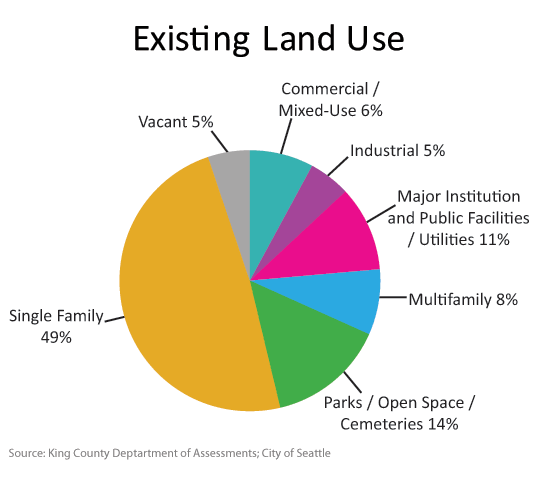
50% of the developable land in Seattle is designated for single-family homes, and not one single inhabitable SFH in Seattle city limits is what anyone would call "affordable". The fact that it's illegal to replace those SFHs with duplexes, quadplexes, or midrises is a primary driver of housing unaffordability.
Seattle's population growth has outpaced its housing growth for multiple decades. There's a huge amount of "catching up" to do, and SFH zoning is blocking that from happening.
Once enough there's enough housing to hold all the rich people that want to live here, of which there are many, you will see some downmarket construction happening. But we're a long way away from that.
They’re replacing SFHs with multiplexes all over the city all the time. Instead of assigning A/B/C units or fractions they just split the numbers already designated for the lot.
Zoning for MFHs won’t change that. It’ll maybe bring more skepticism to luxury developments. But people buying million dollar units with no lot will know they’re buying the same thing.
And mixed use luxury apartments are the only development otherwise. No one is building anything more affordable in zoning more favorable for it. At best this is trickle down economics where everyone who needs somewhere affordable to live might be able to get scraps at the most dangerous furthest flung place in Lake City.
So if this is a "problem" for government to fix via either Zoning being abused or the free-market being naughty, then why doesn't the government just create very specific and targeted "high-density, high-rise, cheap-price" zone that can only be built with the right and necessary units?
Dude have you been to lake city? The only area that’s dangerous is where there city built one street up with all projects. It’s significant safer than Ballard university district and and capital hill
> As of 2019, there were 367,806 housing units in Seattle, representing a 19 percent increase since 2010 (according to Washington State Office of Financial Management). The growth in the number of housing units in Seattle from 2010 to 2019 surpassed the 14 percent growth seen between 2000 and 2010. However, even with the rapid increase this decade, expansion of our housing stock has not kept up with Seattle's population growth of 22 percent between 2010 and 2019.
And here's Seattle's land zoning ("Land Use" tab on the same website):
> Can only speak for my city (Seattle), but no one’s building Camrys and building is constant
I'm in the Seattle metro. Building higher density housing is still illegal in most of the city, because attitudes there are still fundamentally NIMBY, even if it's not as bad as SF.
The city has generally upzoned little slices at a time around 'urban villages', and while that's certainly better than nothing, it's a lot less effective than largest scale upzones, and streamlining building processes.
This is a poor analogy. People rely on cars way differently then they rely on housing. If the only car you could buy was a Lexus, you might stretch you budged, take out a big loan and buy one, or you might simply not buy a car, get a bicycle instead, take the train, a cab, or pay a coworker to carpool.
Housing doesn’t give you this option. If you don’t want to be homeless you may be able to rent, but that is pretty expensive too.
It seems to me like your list has analogs in housing without squinting too hard: spend more of your budget on housing, get a mortgage (big loan and buy one), get a smaller place (bicycle), rent a place (train), or move in with roommates (carpool).
So many landlords have taken old homes and converted them into single apartments, raising the cost without creating any value. I would say destroying something of intangible value as well. That trend has definitely driven the cost of housing up.
Because selling a Camry doesn't reduce the selling price of Lexuses built in proximity to it by more, in aggregate, than the profit from the Camry. Which is why developer-founded and controlled HOAs have much more restrictive rules than public zoning rules.
One theory, and this may just apply to my location, starter homes supply is being eaten up by firms who are going to turn around and rent it out. So they are essentially grab what little supply there is of new construction starter homes, then turning around and renting them out for quiet a bit of a sum that still prices quiet people out of them unless they are fine eating shit.
We don't seem to have an issue with Hertz coming in and scoping up all the camrys.
There are plenty of yuppies to buy up any fancy new houses in town, though. So no cheap houses are built inside the cities proper.
In the US, there's always more land - it's just further away! The cheap "Camry" houses still get built, but never as infill. It just gets pushed further and further out to the exurbs.
Unless you take money (or cheap debt) out of the hands of the yuppies, nothing changes here.
It doesn't really matter if you add new stock at the top end or at the bottom end, people from the bottom move up, and make space at the bottom for new entrants. Any new stock you add increases supply, which leads to lower prices across the board.
[edit] and btw, I think builders aren't tripping over their shoelaces to service the low end of the market because they know the city is so aggressively capping how much they can build. This means they will only build the most profitable units, the high end today. But once the high end is saturated, the low end ones will be the profitable ones anyways.
> It doesn't really matter if you add new stock at the top end or at the bottom end, people from the bottom move up, and make space at the bottom for new entrants.
Only if the old housing stock isn't torn down to make room for the new housing stock. Thankfully property taxes aren't driven in the potential value of land (rather, they are tied to actual value), but most small scale landlords of affordable housing right in it are in it for property appreciation, not rents. Their exit plans are often to sell to a developer as tear downs.
> This means they will only build the most profitable units, the high end today.
There are costs are too high (to acquire property and build) to justify anything but going after the highest end of the market. Once the high end is say satisfied, money (investment) could simply move away from housing if it can't make any money there. Money chases the highest returns between all of the markets, not just one market.
> Thankfully property taxes aren't driven in the potential value of land (rather, they are tied to actual value)
That's not a thankful thing at all, it incentivises using the limited land in wasteful (low-value) ways.
> Once the high end is say satisfied, money (investment) could simply move away from housing if it can't make any money there. Money chases the highest returns between all of the markets, not just one market.
Available capital is practically unlimited these days, anything that's profitable and legal to build will get built.
> Only if the old housing stock isn't torn down to make room for the new housing stock
This is about zoning too. Normally, if the demand is there for it a smart land owner would build more housing on the same plot, e.g. turning a single family into a two family, but of course that is illegal in many places.
Yes, that is exactly what is happening in Ballard (Seattle area) right now. Those cheap 100 year old low income housing complexes (one or two stories) are being raised for a bunch fo three story townhomes, smart developers can sell each of those town homes for $1 million each, and they could get much less if they kept it as a hotel-like complex. I just bought one of those town homes, so I'm not going to complain too much, but I'm self aware about what is going on here.
So poor people are still getting screwed. My daily walk to the grocery store passes by a few places that are pretty shabby (so low income) and right across the street they are building a bunch of luxury town homes. It doesn't take a rocket scientist to figure out what will happen to those shabby places in a year or so.
> a smart land owner would build more housing on the same plot
This is an uncomfortably extremist position, should maximizing revenue per investment be the one and only consideration society takes into account?
I do many things that provide joy in life in other ways, even if I know they don't maximize revenue or savings. I wouldn't want to go through life thinking about nothing else than ROI for every action.
>property taxes aren't driven in the potential value of land (rather, they are tied to actual value)
That means multifamily properties have higher tax bills for absolutely no reason. Expensive locations need to provide more housing per area so charging a fixed fee based on the value of the land is a much better approach. You get to build a single family home and pay through the nose or split the bill with a multi family home.
I hear this repeated a lot. In practice, at least in the cities I've lived in, I've only seen housing go downmarket when there's an explicit exodus. The reason is that housing is built for a specific living space size. Los Angeles has so many single family houses that it's impossible to cater to people downmarket...unless houses are torn down and multi-unit housing is built. You could rip those down and build upscale, large apartments, but I feel like I see them sitting vacant instead of moving downmarket. The bust sucks for everyone and the boom (gentrification) sucks for the less well off.
Maybe we're saying the same thing, but instead of gradually reaching a equilibrium like you're describing I see a dramatic boom bust cycle--both are held back by lack of building.
> It doesn't really matter if you add new stock at the top end or at the bottom end, people from the bottom move up, and make space at the bottom for new entrants. Any new stock you add increases supply, which leads to lower prices across the board
I could definitely see that being how it works in a lot of cases, but it seems like a stretch to assume that's some sort of natural law of prices. If I have a market of ten potential buyers, the first who has $1, the second who has $2, and so forth until the tenth buyer has $10, I could put an infinite number of goods for $10 for sale, and none beyond the first would be able to be purchased. Sure, you could argue that it would be silly of me to price in that way, and you would be right, but in reality you don't know the exact financial details of every potential buyer of your whole market. GP is hypothesizing that basically this exact scenario is happening with housing, and I don't know if they're right or not, but your rebuttal doesn't seem very convincing that this is an impossibility.
My point is that it's at least mathematically possible for a scenario to exist where the assertion I was responding true does not happen. If the idea is that _in practice_ people always lower the prices, then it seems more direct to just say that rather than claim some sort of law of economics that doesn't actually have any mathematical proof.
If they priced at $6, they’d sell 5 units for $30 and 5 people would still be unable to afford to buy housing while the seller held onto 5 more units waiting for another person to come along with $6. If they priced at $7, they’d sell 4 units for $28, which still might be better for them.
This might not be that far off from what’s happening.
We have the same problem with the car market. I can only afford a $5,000 car, but the car manufacturers make all their money building $20,000 cars. I just can't see how Honda making another $20,000 fit is going to help me afford a $5,000 car.
The problem from the manufacturers' perspective is that the gear required to meet 2021 safety, emissions, and fleet efficiency standards by itself almost pushes a new car's price over $5000, and that's without leaving any budget left over to make it a car anybody would want to buy.
They do sell vehicles at that price which get around all of those standards, but they lose two wheels in the process.
You used to be able to buy a decent used car for $5k but as of recent you can't find any without connections. I've been telling folks interested in Japanese cars that it's $10k at this time to buy used with low mileage for a sedan and $15k to buy used with low mileage for an SUV.
I mean VW makes $100,000 Porsches and $20,000 Jettas. At some point it’s not economical to make cheaper cars due to materials and workmanship. You can certainly buy an e-bike for half that, I did.
The cost of construction in America is $150/sqft. We’re not even close in cities. Off by an order of magnitude.
Sorry I guess I was more obtuse than I intended. My point was I can buy a used car for $5,000, and Honda building new cars allows that even if the new cars are out of my price range.
Some analysts believe that in another 5-10 years in the US, you'll get if not quite a $5K USD car off the Internet, a $10K USD car from a Chinese manufacturer, and the Detroit automakers will reprise their arrogance-into-bankruptcy role from the 70's again when Japanese cars entered the US market, when they famously remarked the new entrants can have that cheap unit market.
Watching the Detroit product roadmaps, I'm inclined to agree with that analysis at this time.
In cities with no zoning todays luxury housing is tomorrows affordable housing. For example in Houston apartments and houses that were touted as luxury in the 80s are slums now.
This also holds for smaller cities in the Rust Belt. My childhood home, purchased almost new in 1980, is only worth about 2x what my parents paid at a time of 20% interest rates. It has been very well kept and sits on about an acre and a half. Everyone with means has moved away. Retirees and people with no better options are all that's left.
We're seeing a massive demographic shift to single person households all across the first world countries from Canada to Korea. But for some reason the housing market is still geared towards families.
Households with two or more incomes are more likely to be able to afford real estate than single-income households - both in absolute income levels as well as in economic crisis where it is less likely all family is losing their all of their income simultaneously than a single person..


And in cities, the lot cost is very prohibitive too, before even getting into building a very basic house.