IMO, I don't think it should be a surprise that we will eventually find signs of extraterrestial (but not necessarily intelligent) life in our solar system. The real question is: does it share any common building blocks with life on Earth or not? The answer to that question could dramatically change our understanding of our place in the universe as well as open up entire new fields of productive research in biochemistry.
Anyone who has tried to keep their culture plates sterile in a lab will probably appreciate panspermia more than regular people. I'll personally put all my money into life being found at least fossilized not just in Mars but in europa and anywhere with liquid water, and sharing the same fundamental dna-protein-genetic code makeup as us (but probably little else). The way I see it, once life forms on one planet, it probably starts spreading seeds on a cosmic scale quite promiscuously. The speed at which life arose in earth as soon as conditions were right suggests that there's always microbes floating into the planet ready to take advantage.
This also would mean that there's no opportunity for any other form of life to develop in the same conditions - dna based life probably has a monopoly on water based planets throughout the galaxy
I think you are substantially underestimating the scale of the galaxy and the vastness of space to make a claim like "dna based life probably has a monopoly on water based planets throughout the galaxy"
I'd argue you are also substantially underestimating the scale and numerousness of biology: your body alone has more bacterial cells than there are stars in the observable universe - all you need is one viable cell to seed an entire planet. A planet teeming with life if it was shattered due to a collision would catapult billions or trillions of seed containing rocks across the galaxy. We have three unfathomable scales competing each other - light years in distance and 100s of billions of stars, billions of years and quadrillions or more of seed cells potentially floating in space. Of course any of these factors could he off by a few orders of magnitude but it's hard to suggest one hypothesis is more valid than other without data.
Assuming some of the life-containing mass ejected from the collision had enough velocity to fully escape the gravity of not just the colliders but the entire star system it started in, that life would have to then survive for probably hundreds of thousands or millions of years of transit _and_ the re-entry and impact on the other life-sustaining planet it hits (assuming it hits anything, or doesn't fall into a star instead).
I'm not saying it couldn't have happened, but even on a cosmic scale it sounds like it would have to be an exceedingly rare outcome.
Reentry develops sufficient heat that any complex organic molecules are torn apart by their thermal energy. And the impact is severe enough that it would likely destroy what was left.
1K is not absolute zero, 0K is. 420K is 150°C, barely above boiling.
In space, your temperature may range from 0.01K to over 2000K depending on solar radiation levels over the spectrum.
You're exposed to higher levels of radiation and vacuum will tear at organic structures.
A tradigrade can probably survive a trip to mars if they're very lucky. Better to send a huge amount of them, maybe one makes it.
But interstellar distances are too vast and the time taken is too long. The DNA within tradigrades, even when hibernating, will have been torn to shreds and with no energy to repair there is no way back to life from that.
I will quote form the article:
> Back on Earth, over 68% of the subjects protected from solar UV radiation were reanimated within 30 minutes following rehydration, although subsequent mortality was high; many of these produced viable embryos.
And that is after 10 days of exposure. If it was 400 years, it's unlikely that even 1 is able to reanimate.
The hydrates species fared much worse and hydrated is more likely the state of the tardigrade when they are blown into space, rather than carefully dehydrated.
> Some of them can withstand extremely cold temperatures down to 1 K (−458 °F; −272 °C) (close to absolute zero), while others can withstand extremely hot temperatures up to 420 K (300 °F; 150 °C)[36] for several minutes, pressures about six times greater than those found in the deepest ocean trenches, ionizing radiation at doses hundreds of times higher than the lethal dose for a human, and the vacuum of outer space.[37] Tardigrades that live in harsh conditions undergo an annual process of cyclomorphosis, allowing for survival in sub-zero temperatures.
A quick DDG search says 10^13 bacterial cells in a human, 10^12 galaxies in the observable universe and 10^8 stars per galaxy. Your hyperbole is very off. The rest of the argument is not unreasonable, but not evidently convincing either. Certainly inspiring to think about though.
And I think you are underestimating how hostile space is to life. Tardigrades can make it, to some extent, for a limited amount of time. Doesn't mean all life is invulnerable to near absolute zero temperature and constant radiation. Add to that the temperatures a meteor reaches when they crash through an atmosphere, granted without much an atmosphere there isn't much to generate friction. Yet the impact would still be devastating.
It's certain we still don't have enough data to make any conclusions about how easy it's for life to spread. I'd wager it's less than expected yet in our galaxy, my guess would be that either hundreds or dozens of planets/moons contain life. Depends on the statistical distribution of the occurrence of life.
Serious question here, but are there any concerns about potentially finding some type of non-intelligent life that could threaten us? Some kind of bacteria like organism that could wreak havoc on mankind? I’m sure there are a ton of strict processes around returning samples back to earth but I’ve never really read anything mentioning this threat when it comes to finding life outside our planet.
It seems pretty unlikely, albeit not impossible. Life on Earth has evolved over an extremely long period, and advanced species have very robust immune systems against cellular life. When you consider that Earth already has viruses and bacteria that adapt very rapidly, that have spent eons competing with existing life — I think it's unlikely we'd find an bacteria or virus that could successfully infect Earth based organisms in a way that threatens us.
We're going through a pandemic right now because a virus has successfully found a way to evade our robust immune systems.
You can take a country as deadly as Australia and introduce something as innocuous as 24 rabbits, and it can have an absolutely devastating effect on the ecosystem.
Frankly it's beyond hubris to suggest that we'd be fine just because of the way we've evolved.
A virus that co-evolved along with us, specifically being able to infect complex cellular life in the way it has evolved on earth. Anything from another planet wouldn’t have developed in a way that lets it get past our immune system not because or complexity, but because of lacking the shared evolutionary history.
Something that represented a danger to us from another planet would have to be an issue in how simplistic it was...like mad cow disease style prions, or a parasite that happens to attack us in a novel way. Something virus like just wouldn’t be an issue.
>Anything from another planet wouldn’t have developed in a way that lets it get past our immune system not because or complexity, but because of lacking the shared evolutionary history.
Based on?
Rabbits didn't co-evolve with australia's deadly fauna, and yet...
Well, this also works from the opposite perspective: we have evolved to combat earth virusses, but haven't evolved to combat anything from another planet. Lacking the shared evolutionary history may leave us more vulnerable.
An alien virus would have to be very lucky indeed to have the necessary machinery to dock to our cell's and inject itself into the cells replication mechanism. Viruses are often not even able to bridge the gap between relatively closely related species. A alien virus being able to infect Earth life seems vastly less likely than a virus that infects sea sponges being able to infect humans and nobody really worries about that.
It wouldn't have to be some form of virus to be deadly though, right? Something like prions or unlike anything we know could be equally (or more) deadly to us or even all life on earth. Our imagination is quite limited in this domain and well let's hope it stays this way..
(not that I find any such scenario to be even remotely likely)
Edit: well, that's basically what's being said in a parent comment
if an alien life-form is DNA based, maybe other similarities are shared with Earth based-lifeforms, even if it doesn't share an evolutionary past with it.
Right, I just saw this after replying to a different comment, but I think a COV-19 type scenario is probably the most likely of a bunch of really unlikely scenarios. Its unlikely an alien virus would be able to interface with a human virus, but if they managed to exchange genetic material, then it's possible the hybrid could infect a human. The same reason makes these types of pandemics from local viruses nearly inevitable. The proximity accelerates how viruses evolve and jump species. We obviously don't know enough about life to know if viruses are a universal phenomenon such that they could interface on first contact.
It's super unlikely that a virus that evolved outside of Earth would (on its own) have a mechanism to infect cells they hadn't encountered before in order to propagate. Again, nothing is impossible, but physics, chemistry and biology would all have to line up in a very specific way for that virus to infect a human cell.
If the standard expectation is to find DNA based life-forms, it could be fairly rational to suppose that alien life shares other evolution tricks with the Earth based life-forms.
So alien viruses could directly and initially interface with Earth based life-froms cells (humans,the biota inside the humans, etc.), with probably also, somewhat predictable results. Or at least novel coronavirus like outcomes.
> So alien viruses could directly and initially interface with Earth based life-froms cells (humans,the biota inside the humans, etc.), with probably also, somewhat predictable results. Or at least novel coronavirus like outcomes.
Entirely possible, but COV-19's novel spike protein was developed through brute-force trial and error. An alien virus would need to do so via happenstance.
That's just another nice way to describe evolution. It's just a storm of probabilistic biochemistry. I think if you read about how fast and crowded biochemical interactions in the cell are [1], you will quickly appreciate that's it's basically just quadrillions of hypersonic processes doing what you describe as "brute-force trial and error".
For example, that's how a good number of drugs work that attempt to bind to some protein, like Aspirin. They don't go and find it. The drug molecules enter the cell space and just bang around at incredible speeds until they finally just jam into the protein they need to. Brownian motion and similar effects and not some taxi service to the target protein. It's basically just probability which is where concentration comes from. Increasing the probably of the drug molecule hitting the target.
That's also why I really dislike the personification of things. SARS-CoV-2 didn't consciously do anything. I know most people know, but the language constantly insinuates just that.
There's a very very big difference between a virus who has evolved alongside other living beings on this planet for millions of years and finally made the jump from one specie, vs some form of life that has probably been separated from us for billions of years. The former has very specific mechanisms that has evolved to perfectly trick our defense system, not too much to kill us instantly and not too little to not spread. It's perfectly in the goldilock zone. The latter on the other hand has never come in contact with anything anywhere close to our life form.
It really depends on what ET life looks like. If it shares a common set of DNA for example then it would be much more likely that it could be dangerous. But if it’s not even Carbon based then it could be totally inert to us and vice versa. The biochemistry might literally prevent all interactions. We won’t know until we can examine it up close.
Australia is a small continent isolated from a big world. Australian animals did not have as much competition as rabbit had during his evolution. So rabbit from Eurasia in Australia is like Earth bacteria wreaking havoc in some small oasis of life at some distant planet. It works that way, but it won't work other way. It took hundreds of thousands of years of constant evolution for COVID virus to break through our immune systems. Martian bacteria won't have that time.
Now if some otherworldy life had billions of years of evolution similar to ours or exceeding it, well, it might present some threat.
I agree with you. In the vastness of time we've been here just a moment and we are precariously balanced on the top of a food chain that we take for granted.
I second this - think about threats from other animal kingdoms, say plants - they get infected by bacteria, viruses or parasites. Yet no-one has ever managed to infect an oak with flu, or to get yellow rust from wheat. Anything actually alien is going to be further removed from me and you, than we are from jellyfish. The bodies will be just too different.
Maybe some kind of invasive organism could exist that spreads like kudzu and plain outcompetes existing life -> however this sounds like something that could be controlled by brute force.
This is the same reason humans can eat most fish and nearly all plants raw. The evolutionary distance is so high that infection is basically impossible.
What could still be very dangerous, is otherworldly defence mechanisms like toxins. Plant and fish toxins are commonly deadly to all higher life forms
"... slain, after all man’s devices had failed, by the humblest things that God, in his wisdom, has put upon this earth." - I suspect this might be a more likely outcome (courtesy of Wells). A single strain or a novel virus is far more likely to have a predator on earth than be a predator to something we need to survive.
That said, it would be prudent to take anything that may be living to the ISS first.
I'd like to say that I disagree here with your assertion that this may be an unlikely scenario. I think it's more of an unknown. We don't know what unique capabilities an independent virus or bacteria may have generated. If you look at human history, contacts between peoples with different immune system resiliencies proved quite deadly. It's possible that we encounter a novel virus or bacteria and it may be extremely lethal or damaging with no ability for our immune system to fight off the infection, or it may not have an ability to interact with our cells and thus pass through without harm. Or anything in between. This goes both ways.
The infections that happened throught the history of human colonization do not apply here. Those were just what microbes had evolved for, finding untrained or weakened immune systems to infect.
Martian life, if any, should simply be "trained" to pry on the particularities of its own environment, not ours. There's a extremely low chance that it could survive and thrive on our warm planet. Add to the fact that lots of precautions will be in place, Martian life exploration can be considered very safe for Earthlings.
However... since life evolves to be successful in (almost) any environment, Martian life could just as well be trained exactly for these rare moments: to be dormant then suddenly pry on unsuspecting alien visitors that come snooping around... But then that would be the argument of a successful Ridley Scott movie franchise.
If we assume that life readily emerges, that's evidence that the life that predominates on Earth is robust as presumably it has overcome many spontaneously emergent forms of alternative Earth life, and possibly even extraterrestrial life.
But if life doesn't readily emerge, then we don't have any evidence one way or another. However, the likelihood of encountering extraterrestrial life is also diminished.
I’m not sure that I understand your point here. Could you elaborate? I understand that life on Earth has gone through billions of years of intense competition for survival, but I’m not sure that we should assume any likelihood of how an interaction with an alien organism would go given we haven’t found life outside of our planet and we can’t be sure of the evolutionary path it may have taken.
If life is as common/likely as some believe (that is to say, "very likely" or even "inevitable if liquid water"), then it should be continually emerging on Earth in various forms. The persistence of life as we know it would therefore imply something about its robustness--its ability to outcompete those alternative forms. Such evidence certainly wouldn't be dispositive, but it would be evidence nonetheless, the strength of which would be a function of the likelihood of spontaneous life.
"But", someone replies, "I'm talking about life forced to evolve under extreme and alien circumstances." But Earth has plenty of extreme environments, both now and especially early on, and scientists optimistic about the likelihood of spontaneous life are constantly equivocating those environments to others in our Solar system and beyond. Plus, let's not forget that the modern, biologically created Earth atmosphere is something of an extreme environment of it own. So no matter how you spin it (I'm too lazy to put down several other scenarios I've had in mind), the more likely we are to encounter extraterrestrial life, the more robust Earth life likely is.
If random independent life emerges on Earth now it's not surprising old life that had billions of years to optimize for the environment and in general just outcompetes it immediately.
Expecting the opposite would be like betting on a random path in a graph with millions of edges to be faster than a path that was optimized by billions of computers for billions of years.
It's not that old life optimized for killing the new life (it probably didn't because it doesn't seem to be a common enough occurence). It's that the new life would be very likely very bad at everything.
Yes but my post that you were responding to was a response to that comment specifically. I appreciate your comments here, I just want to make that clear.
> If you look at human history, contacts between peoples with different immune system resiliencies proved quite deadly.
Between human species on Earth. Humans in the Americas were not genetically distinct from their European cousins, thus a European virus could readily infect an American human and vice versa (Europeans were not wiped out because the diseases they acquired were not as deadly, such as syphilis).
Our immune systems are adaptive, but a bacteria/virus will be limited in it's ability to adapt. As such, it's pretty unlikely to be able to infect a complex, multicellular organism that it's never encountered before. The most likely vector for an attack is an alien bacteria that is able to rapidly transpose genetic code with earth-evolved bacteria and create a novel hybrid. Then you are dealing with a COV-19 type scenario.
Yes my point want that such a meeting would be similar, but that such a meeting between alien ecosystems could have a similar effect. To the larger point about the OP, my issue is the idea that any of this is unlikely, when there is a sufficient lack of information to base any sort of probabilistic assumption. They’re all simply incorrect because there is insufficient data. For all we know an alien organism may be specifically evolved to devour multicellular life, or pass into other organisms without detection. There is no reason to think the Ridley Scott scenario is any more or less likely than a harmless scenario. We just don’t know because our frame of reference is only life on Earth.
Sure, I get you. There are all kinds of possibilities in a vast universe. If, for the sake of discussion, we can assume that alien bacteria and viruses have roughly the same physical constraints — it's pretty unlikely you see that kind of adaptive behavior toward multicellular organisms. There is a physical limit on the size of bacterial genomes and viral RNA is a single set of instructions that get inserted into the host's own genome, so they literally can't be that complex. Every bacteria and virus on Earth targets a specific host, environment and/or life cycle - they have to specialize and adapt to survive.
That's not to say we couldn't inadvertently pick up a bioengineered complex organism from an advanced alien species - that would be a completely different story.
Frankly we won’t know until we find ET life. If we’re talking about something that is relatively similar to a Terran bacteria then perhaps it could interact with our cells.
Alternatively, it is probably far more likely that life from Earth would rapidly evolve to kill or replace any extant life on other worlds, especially microscopic life. We know that Terran life is tenacious. It readily thrives in hostile environments and has evolved under extreme adversarial pressures on Earth. It’s not a stretch to imagine that it could become the apex predator in an ecosystem devoid of such extreme evolutionary pressure.
Indeed, if alien species are so environmental constrained, the competition to thrive could be almost non-existant, and Terran life could have the winning hand in that case.
We should be careful about what we send to Mars. Something like candidas aureous could just wipe out the life on the planet.
we know quite a lot about this, most life-forms on Earth almost continously try to kill humans or at least to mine its biological resources for its use.
I think the opposite is actually a much larger concern. It seems more likely that introduced Earth organisms would destroy native extraterrestrial ones. Or at the very least contaminate any samples.
Rocks have been exchanged between solar system bodies for millenia. We know that life can theoretically survive on these meteors.
So it seems rather unlikely that a foreign life form that is not well adopted to life on Earth has a big chance of survival.
we could have had already some encounters, maybe some current life-forms in Earth were actually alien-forms initially (somehow octopuses comes to mind).
Some people on the net says that the current coronavirus situation could be an alien-species. I know it is FAR FAR from anything related to what we already know about the virus.
But it gives an idea about what could have looked an encounter with a new alien-patogen which just landed on Earth at some point at history and got to survive and thrive in the local ecosystem.
That's like asking if we could find a virus on some old mineframe that by accident works better than modern computer viruses on the newest version of linux :)
It's very very very unlikely it will even be able to run at all. It would use a different machine code, even if it was by crazy accident the same it would use some long forgotten binary format instead of elf and depend on different directory structure. It wouldn't be adapted to modern protection schemes like stack randomization.
What about something that eats proten and requires water. A fungus comes to mind. If you are talking Virus, it needs to be able to highjack teresterial DNA, a fungus or similar only needs to find us tasty.
Yeah, viruses need to coevolve with their prey. Which is why the computer virus in * Independence Day* was so silly.
And I think terrestrial immune systems can handle microorganisms, whether they're DNA based or not. It hunts based on shape, as I understand it.
I was thinking microorganisms, since anything big we can just kill on sight. But when you mention it, something insect size could be very hard to fight.
One school of thought is that extraterrestrial pathogens could pose limited risk. Earthbound pathogens have co-evolved with humanity in order to harm us better, but xenobiological pathogens would not have this advantage and might not pose much of a threat.
On the other hand, it's entirely possible that the random chances of evolution could create a xenovirus that's airborne in humans and bootstraps a fatal prion disease in everyone it infects.
Something like a bacterial infection might pose a problem as it is just eating simple sugars and multiplying, but is completely novel to our immune system. A prion seems unlikely.
We know that if we apply an energy gradient through a soup of ammonia, methane, and water vapour, we get the fundamental building blocks of Earth life.
If we discovered these same blocks on another planet, that has all of these pre-conditions, what would it tell us?
DNA with different chirality (would likely prove distinct origins better than genetic overlap, if life was seeded from the same origin billions of years ago there could be no overlap today, and some overlap doesn't prove origin either since gene can develop independently even very specific mutations), proto-life - RNA world/self replicating proteins...
Both of those would likely be a "more interesting" thing to study.
The most boring part would likely be finding DNA life which is quite similar, I'm not sure it would point to any specific origin and if it's metabolically going to be quite similar to some life we can find on earth the overall new science from it might be fairly limited.
It would imply their extinction far into the future, after they've evolved to our level of intelligence, since our existence implies that the Great Filter exists ahead of us, not behind us
I don't think we know enough to say that for sure. If you are defining the great filter as the cause of the Fermi Paradox then it very well could be in our past. For example, the conditions or specific mutation that gave rise to multi-cellular life could be the great filter meaning that single celled life could be incredibly common but multicellular life might be almost entirely non-existent.
We might want to say that our existence is some evidence that the filter is ahead of us but it could certainly be behind us (in which case the logic of the Great Filter doesn't apply for our civilization)
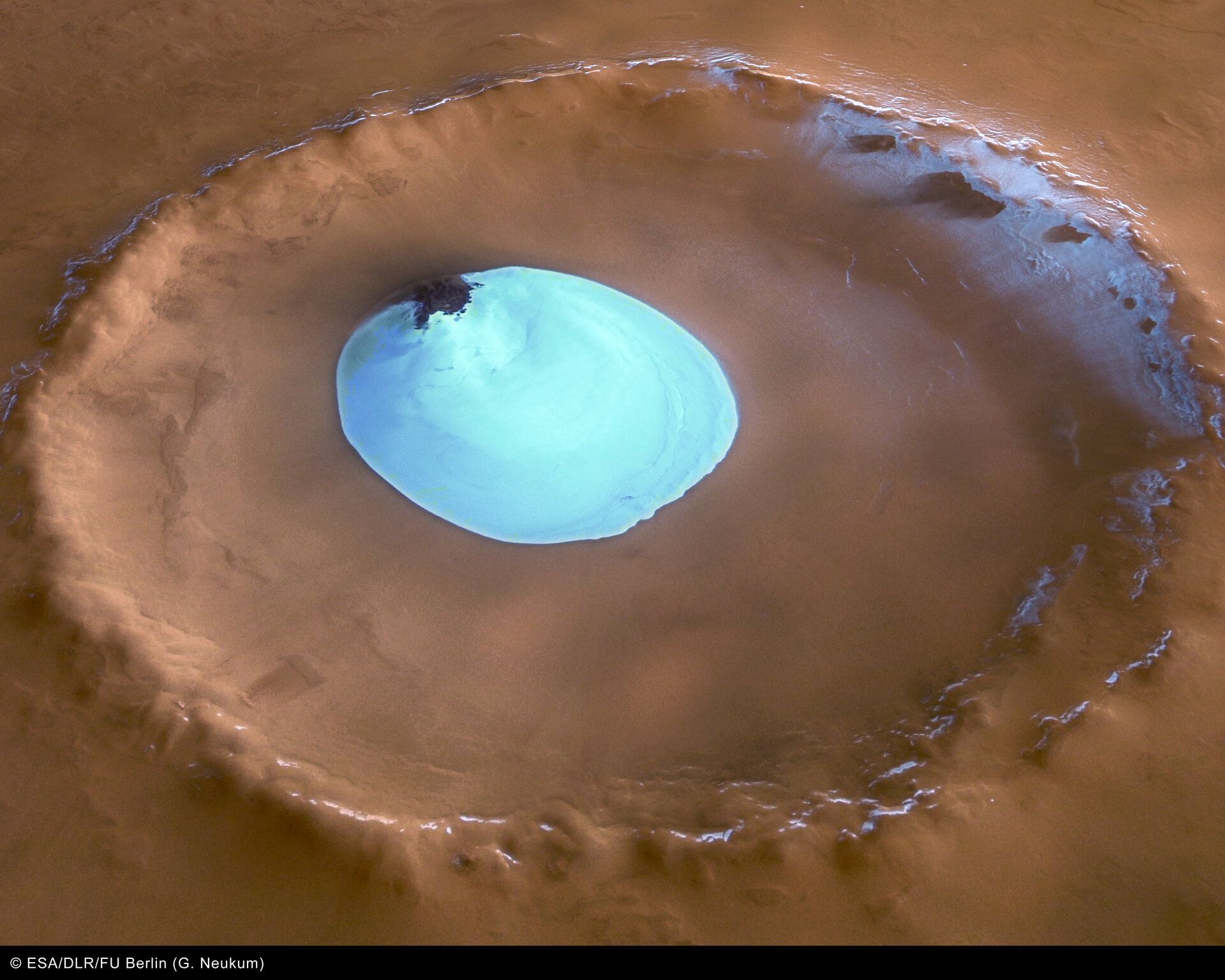
Seems to be easy to confuse since the crater seems to have the same name "Vastitas Borealis Crater" [0].
Do you know if it's actually called "Vastitas Borealis Crater" or is it just simply a crater in the region Vastitas Borealis?
> The 35-kilometre-wide crater sits 70° north of the martian equator, in a low-lying region known as Vastitas Borealis. Previous orbiters have spotted ice deposits in craters, but the High Resolution Stereo Camera on board the European probe is the first to return a three-dimensional colour image of an icy spot. The ice may be up to 200 metres thick, and lies over a dune field that has formed in the sediment on the crater's floor. The data were collected on 2 February, and this image was created for Nature last week. [1]
Unfortunately it's at far too high of a latitude - in addition to the solar power problem, it's also far too cold to send affordable hardware.
There's lots of water ice elsewhere on Mars in much more friendly latitudes (Arcadia Planitia is the region I've seen bandied about most often).
At lower latitudes you pick a site where the ice is either not too far underground, or exposed through some exotic action like a calving cliff face (though the latter are usually less convenient for landing).
I wonder how the affordability equation would change with a nuclear power plant. It could be pretty light weight, there is no need for shielding, and the water could possibly be used to cool it.
Unclear - NASA is currently working on the Kilopower reactor, which is probably lower-power than the enormous solar arrays SpaceX is considering. However, if they're expanded into the megawatt range they could be usable.
Shielding is still required, as humans are not the only thing that's vulnerable - electronic and chemical systems are also vulnerable. Burying the reactor in Martian regolith is probably a more risky project than unrolling a massive solar array.
The other problem is the cold. At low latitudes, the temperatures are at a relatively warm Antarctica-like level, sometimes getting to room temperature at the equator at noon. At high latitudes, though, we're talking cryogenics - lows of -150C, averages of perhaps -100C. Making machinery work at those temps is expensive.
I don't understand any of this. On Mars there's a lot of radiation anyway, and humans shouldn't go near the reactor after it's going critical. I don't know what you mean by chemical systems. The point is the reactor doesn't have to be buried, just put it so it's in a crater or behind a ridge (as seen from any settlement) and the radiation is not a problem.
As for cryogenics, either make sure it never drops to cryogenic temperatures in the first place, or make something which can be stored at these temperatures. Once it's operational, the temperature should never drop ever again until it's decommisioned.
The cold is a problem not for the reactor itself (it'll heat itself up quite nicely) but for the other gear involved with a settlement. Chemical plants, mining bulldozers, habitat seals - all of these things get seriously weird when you bring them down to ~125K. (For example: IIRC sabatier plants need to run in the high hundreds of K; if you're going to keep that going in a cryogenic environment you need either an enormous amount of insulation or to be willing to lose a lot of energy to the environment.)
The obvious solution would be to use waste heat from the reactor in a combined heat and power installation, but then you run into the radiation problem. Coolant tubes or heat pipes that run a significant distance are heavy and bulky, but if you want to move your gear closer to keep that weight down you get in trouble from radiation. Note that it's not just people that are sensitive to radiation - the chemical beds required for fuel and oxygen production, electronics on any moving rovers. If you just want power, that's fine, bury it a few km away; but if you also need heat you're out of luck.
So much of astronomy and planetary science focuses on water right now. Here are some more recent results about water:
- The bright, salty deposits that NASA’s Dawn spacecraft spotted on Ceres likely come from briny water escaping from a 418 km across underground reservoir 48 km below the surface (https://www.nature.com/articles/s41550-020-1138-8). Two reservoirs were spotted by analyzing the dwarf planet’s gravitational field. The salt deposits are young, suggesting that Ceres, the largest asteroid in the solar system, is still an active world. Ceres joins the growing list of solar system bodies that likely host hidden oceans: Enceladus (now with recently detected fresh interior ice), Europa, Ganymede, Pluto, and subglacial lakes on Mars.
- Some of Earth's water may have come from the breakdown of organic space-born molecules (https://www.nature.com/articles/s41598-020-64815-6), while the rest could have come from hydrogen locked up in enstatite chondrite meteorites (https://science.sciencemag.org/content/369/6507/1110), instead of being delivered by comets and carbonaceous chondrite meteorites that formed beyond the snow line, as has been previously assumed.
- Juno took the first image of Ganymede’s north pole (https://www.missionjuno.swri.edu/news/nasa-juno-takes-first-...). Ganymede, a moon larger than the planet Mercury, is made mostly of water ice. The ice near its north pole appears to have been altered by Jupiter’s intense radiation to become an amorphous material without crystalline structure.
It will perform "45 flybys of Europa at closest-approach altitudes varying from 1700 miles to 16 miles (2700 kilometers to 25 kilometers) above the surface", so there's no plan of landing to my knowledge. I also recall a mission to fly through the geysers, but am not if that's the one. I for one however am eager that we start digging in there once we're ready.
The more we learn about our place in the universe, the more we realize how insignificant we are.
I'm now expecting life to be ubiquitous and intelligent life to be rare, yet not unusual.
If only 0.001% of the hundreds of billions of galaxies in the observable universe contain intelligent life and moving from one galaxy to another is prohibitive, that would mean 1 million instances of intelligent life scattered across the universe.
We wouldn't be special, but we could hardly detect or even interact with other intelligent life.
You are looking only at one dimension: space. But you are forgetting time. Intelligent life on Earth has existed a minuscule amount of time in the span of the universe. You need also to take into the probabilities that we would overlap with another intelligent life on the timeline.
Good point. Perhaps we ourselves originated from von Neumann probes in the form of single cell organisms, flung into space in all directions by a long gone, highly developed civilization?
We don't know how long intelligent life lasts on average. Looking at our current trajectory i'd say chances are that technical civilizations are rather short-lived.
PS The Paleozoic began with the Cambrian explosion 541 million year ago, that's quite a long timespan with intelligent life (not a technical civilization, however) even in galactic timescales.
Consider how long life existed before the Cambrian explosion happened though. What are the chances that metazoans evolve from a given planet's microorganisms? One in eight per billion years?
>The more we learn about our place in the universe, the more we realize how insignificant we are.
Insignificant and unremarkable in scale, position and effect certainly. Given that, it seems likely that the presence of life is also insignificant and unremarkable.
That said, it's pretty difficult to overstate the complexity of the mechanisms of life as we know them on Earth. Despite the vastness of space and time, it's also trivial to generate circumstances that are almost certainly unique across tremendous spans of both. So it's entirely probable that we're not alone, and it's also entirely possible that we are. In the latter case, we're still insignificant to a universe that doesn't know we're here, but we'd be sitting in a much more precious place in history.
The term "significant" stems from the person using it, from what they are trying to convey. There are many different ways to think about significance. Significant to whom? For what reason?
Another popular and yet abused argument is saying that human body is "mostly empty space", because the size of the atomic nucleus or an electron is so small compared to the space between them. But so what? It is the interaction between the atoms that matters, that produces all the results including our consciousness, not how much space is between the atoms.
What if we are one of the most significant phenomena and results of the universe, regardless of how little or much space we occupy? Or at the very least, what if the rare occurences of the conscious life are the most significant things in the universe, regardless of how many dead planets or galaxies or space is between them.
Is it really that hard to see that significance can easily be based on something much more interesting and useful than the banal notion of comparative linear space?
This definition of "significance" is not any more or less truthful by any objective standard, so I am wondering why did you choose to use your definition? What does thinking that way achieve for you in your life?
I think you've drastically misunderstood OP, they're not talking about our spacial significance. They're considering given the size of the universe, human-level intelligence (or greater!) most likely exists many times over and is not unique to Earth.
Also I'm not sure why thinking needs to have a "reason" or further some life goal.
Maybe the term "insignificant" was not ideal. What I mean is that we may not be special in any way. By considering this we will set the right expectations as we come up with theories and learn more things about the universe and our place within it. In the past, whenever we thought we were special, we had to revise our theories at a later point.
I think you're right but technically we haven't hit paydirt yet in terms of finding life off earth. Maybe the Venusian probe will be the big breakthrough
When they say "buried lakes" do they just mean region of sediment that is water saturated or brine saturated, like an aquifer? Or do they mean a volume of relatively pure continuous water? Very difficult to tell from the fuzzy language these releases use.
It's not sedimentary areas, I believe, the press release states these are lakes or regions of water (depth not stated). Numerous dissenting viewpoints were brought up about how it may not actually be liquid water, maybe it's slush or some intermediate form of water in these underground deposits.
> It’s thought that any underground lakes on Mars must have a reasonably high salt content for the water to remain liquid.
This means that any lifeforms in that water are unlikely but is it possible that the water remains liquid through something other than salt? Because the other alternative would be a lifeform that isn't influenced by salt as much as any that we know.
I know halophiles typically refer to organisms like bacteria, but one of my personal favourites in that category is the Devil's Hole pupfish, a species found exclusively in Death Valley. They live in water so salty (4x the saline concentration as most other fish) that they actually have to drink the water around them and process the salt internally.
Is anyone else concerned about the prime directive? I worry that our interference could inhibit the natural evolution process to the point that it doesn't happen. I guess that's not to say that some Prometheus-style, ancient alien civilization intervention didn't happen in our history; I don't think we'd ever know. But it seems to me that the genesis of mitochondria is an extremely rare and unlikely event and our interference on these extra-terrestrial bodies may put it all astray. Again, we'd never know... At least not for a few hundred million years.
I would be much more concerned about the 200-2000 species that we knowingly cause to go extinct right here on earth every year than I would be about the vanishingly remote possibility that we may be interfering with an evolutionary leap in a microorganism which may or may not exist.
Jokes aside, If there is any life on other celestial bodies, I wonder if there will be diseases that we carry/they have that would prove destructive to us/them. Or perhaps the biology would be different enough that there wouldn't be a risk.
carbon is unique among elements in the number of molecules it can form. silicon is a distant second and everything else is pretty much a non starter.
water is less of a requirement but you need some kind of liquid for the reactions to occur in and their arent many candidate liquids at plausible temperatures
stability is not a strict function of molecular structure and atomic composition, it is also a function of environmental factors like temperature, pressure, acidity, ...
The reason many of those inorganic polymers on https://en.wikipedia.org/wiki/Inorganic_polymer have a dangling string of "unprocessable" attached is because they're simply reactive with other chemical species (organic or inorganic) in our biosphere, or simply less or unstable at our earthly standard conditions...
if humanity does ever make contact with alien species, we might get tempted to invite them in our Czochralsky crucible if they are rare enough, and vice versa
Likely? No, especially given that most of the solar system is composed of material in similar quantities. It's possible we could find different forms of life-producing chemistry in star systems with different proportions of elements.
I think this question begets the question of how we even classify life that isn't based on Earth's organic chemistry. If we only have one frame of reference for "life," how can we possibly classify or even recognize another that is entirely unlike anything we've yet discovered.
If we ever plan to make a manned mission to that place, we better pack enough water filters and a nuclear reactor, else we solely rely on a mad man in a blue box.