> A Google spokesman on Tuesday confirmed it would scrap the licensing structure, saying this was in line with international rules and followed changes to U.S. tax law in 2017... The tax strategy was legal and allowed Google to avoid triggering U.S. income taxes or European withholding taxes on the funds, which represent the bulk of its overseas profits... Under pressure from the European Union and the United States, Ireland in 2014 decided to phase out the arrangement, ending Google's Irish tax advantages in 2020.
This is fantastic news because laws were changed and that worked.
The criticism towards Google, Apple etc. for minimizing their tax burdens has always been misplaced. Corporations are supposed to maximize profits. And governments are supposed to collect taxes in effective ways.
It's always been a derelection of duty of governments when these loopholes exist in the first place. So it's great news that with enough publicity, democratically elected lawmakers felt the pressure from voters to fix this.
In other words, this is democracy working -- which is always nice to see.
> The criticism towards Google, Apple etc. for minimizing their tax burdens has always been misplaced.
It's a valid criticism if you don't think that "Corporations are supposed to maximize profits" should be true. When anything can be justified because it maximizes profits it becomes very, very easy to be a technically law abiding unethical company which is a net negative on society.
You do want clear rules. An extreme case of vagueness would be: pay whatever taxes you want, but we will criticize and punish you until we think you've paid enough. That would be neither efficient nor fair.
In video game terms, maybe there should be a convention of not taking advantage of exploits, but it's often unclear what's the intention of a tax rule, so fixing the exploit is better.
> > The criticism towards Google, Apple etc. for minimizing their tax burdens has always been misplaced.
> It's a valid criticism if you don't think that "Corporations are supposed to maximize profits" should be true. When anything can be justified because it maximizes profits it becomes very, very easy to be a technically law abiding unethical company which is a net negative on society.
Isn't this why society comes together to form a government and pass laws to prevent these sorts of behaviours?
Not every corporation will be looking to maximize profits, but they're generally all looking to maximize something typically at the expense of something else. From a selfish perspective, externalising your costs is a good thing.
Society is made up of human beings, most of whom are affected by emotions like guilt and empathy. Society works best when we are able to assume good faith from all participants. It breaks down when free riders (those unbound by empathy or mores) reach some critical threshold and then everyone loses trust in the system.
Have you ever been in a group of friends and played a board game where everyone was playing casually to have a good time, except for that one guy? MtG fans call this type of player Spike [1]. Other gaming circles refer to these players as munchkins and they’ve been immortalized in the card game Munchkin [2]. I think most people have played with someone like this before. Their obsession with winning at all costs ruins the game for everyone else.
This is what big corporations are like! They put mom & pop out of business. They drive down wages and destroy the environment. They play one government against the other in order to minimize their taxes while maximizing their subsidies. They are the Spikes of society. We try to fight them with legislation but our laws are always one step behind.
If Google is making an announcement like this, you can be sure they’ve found something else that works even better for them. You can’t expect them to give anything away without a fight.
> Society is made up of human beings, most of whom are affected by emotions like guilt and empathy. Society works best when we are able to assume good faith from all participants. It breaks down when free riders (those unbound by empathy or mores) reach some critical threshold and then everyone loses trust in the system.
Human beings also self-organise and incorporate into groups, which may individually have their own distinct aims. I'm not sure what guilt and empathy have to do with organisations of people though.
"Good faith" is also pretty meaningless, as it doesn't really describe any specific behaviour or motivation. What happens when two individuals (or groups) come into conflict trying to optimise their own outcomes "in good faith"?
> They play one government against the other in order to minimize their taxes while maximizing their subsidies. They are the Spikes of society. We try to fight them with legislation but our laws are always one step behind.
I, as an individual, choose to use a low tax savings scheme to minimize my tax burden. I also make sure to claim every tax credit (or subsidy) that I'm entitled to. Am I a 'spike' in society?
I, as an individual, choose to use a low tax savings scheme to minimize my tax burden. I also make sure to claim every tax credit (or subsidy) that I'm entitled to. Am I a 'spike' in society?
Have you been using “Double Irish” accounting? Do you keep your money offshore and lobby the government for favourable laws that let you repatriate the money while avoiding billions in taxes?
No, probably not. You’re doing what normal people do as part of the game. You probably don’t have your own accounting department with a payroll in the millions whose entire mission is to scour the tax codes of every country in the world, looking for loopholes like this.
A “Spike” is someone who will stop at nothing to win. They bring in the most obscure rules and take maximum advantage of every possibility, convenience be damned. You just sound like a sensible person who makes the best of the laws as they were designed for people like you.
>Isn't this why society comes together to form a government and pass laws to prevent these sorts of behaviours?
No, people form (limited) government to prevent abuse from government.
The idea that a company could abuse you in any substantial way (other than fraud, violating contract terms) must have seemed like an edge case (only the East India Company would have been large enough to present such a threat circa 1775).
So, maybe your claim would work if you consider companies to be a form of government, which is an entirely defensible position.
People form governments to set the rules for their society. You don't get to define what is and isn't legitimate government on principles other than democratic consent.
I think you can accept that corporations have responsibilities beyond maximizing profits, and still find criticisms of tax minimization to be misplaced.
There is nothing inherently ethical or unethical about paying more or less taxes. You should pay the taxes you owe, but the law is what tells you how much you owe. Here, for example, the United States believes it should collect taxes on profits a U.S. company makes on sales in Europe. While that is itself dubiously moral, that's the law. But how can it then be immoral to take advantage of Irish tax laws--which Ireland deliberately adopted to encourage companies to move IP and skilled workers to Ireland--that is also legal under U.S. law?
In the US pubicly held corporations have a legal obligation to act in the interests of their shareholders. Not always, but typically this means maximizing revenue as that's how the company provides value to it's owners.
That does not require them to maximise their immediate profit, like they have just about to go bankrupt, though. They should strive to maximise overall return to shareholders.
How about "corporations are supposed to take advantage of things they can take advantage of to better their position"? If a corporation believes they are a net positive for society, then any advantage they can get furthering their own abilities is viewed as a net positive.
But replacing "corporations are supposed to maximize profits" with "corporations are supposed to fund the president's trips to his private golf resort" hardly seems like a step in the right direction.
Without contextual detail, paying more than the minimum taxes required by law is not necessarily the moral choice.
> technically law abiding unethical company which is a net negative on society.
Debatable - capitalism took 7 billion people out of extreme poverty, eradicated diseases, improved literacy, decreased child mortality, and increase life expectancy. All thanks to companies maximizing profits while abiding by the democratically enacted laws.
Honestly I think the real dereliction of duty here is that not everyone have the same opportunities to plan their taxes like the big boys, and if you call the tax man for help they're obviously not going to do anything for you.
I have some pretty basic, perfectly legal and not unethical optimizations applied to my tax foot print, but I had to hire an accountant to make it happen because I couldn't figure it out on my own. (How do I know it's legal and ethical? I checked with the tax man and they said as much.)
My opinion is much the same as yours, government should work to make taxes fair and clear, and do away with loopholes. But I also feel a large part of the unfairness is that you have to spend a bunch of money on accountants and lawyers to sort things out for you in the first place. I'd like to see at least some basic fiscal planning services provided for everyone, maybe that could help level the playing field a bit. But tax planning is such a taboo subject for some reason, even though it's perfectly legal and acceptable.
> The criticism towards Google, Apple etc. for minimizing their tax burdens has always been misplaced...
I strongly disagree. There is nothing wrong with expecting people to behave ethically. Hiding behind "maximizing profits" because "corporation" is nothing but a weak excuse for greedy people.
I think the last 60 years has proven Milton Friedman was inarguably wrong. Both with the idea that trickle down economics is a valid fiscal policy and that it is always in a corporations best interests to prioritize maximizing profits.
The fact we’ve just gotten to a place where we consider it a fact of life is concerning.
> I think the last 60 years has proven Milton Friedman was inarguably wrong.
The last 60 years have proven exactly the opposite. Almost every Western country that flirted with socialism in the 1960s and 1970s has move back towards free markets and deregulation. Canada's government spending as a percentage of GDP has dropped from over 50% in the early 1990s to about the same as the U.S. today. Sweden's has dropped from over 65% to under 50% since 1995. The EU has become a powerful pro-markets, pro-deregulation force. The sort of practices Friedman criticized, such as the government deciding how much airlines could charge for tickets, were routinely accepted even in the United States 60 years ago, but today are unthinkable even in Denmark or Germany.
At the same time, countries in the third world have liberalized their economies, including China and Vietnam. Today, 95% of Vietnamese and 76% of Chinese agree that "most people are better off in a free market economy, even though some people are richer and some people are poorer." https://www.vox.com/2015/5/3/8539365/vietnam-capitalism-pew
Simultaneously, we have seen the greatest burst of prosperity in the developing world in recorded history. Since my family moved to the United States from Bangladesh in 1989, per-capita GDP (adjusted for purchasing power) has tripled. The infant mortality rate has been cut by 75%. Life expectancy has increased by 15 years. This is a story that has played out all over the developing world, thanks to free markets and the investment and economic growth they enable.
You'd have to be blind to deny that Milton Friedman was generally right (if not about all things, certainly about general principles).
American total compensation has grown steadily since the 1970s. Wages have been stagnant because almost all that growth has been eaten up by rising healthcare costs: https://fee.org/articles/dispelling-the-myth-that-wages-have.... That indicates a problem with our healthcare system, not a structural problem with the economy. (Likewise, if you look at returns to capital, they have been stable since the 1950s. The decrease in returns to labor have come entirely from increasing returns to real estate. Again, that’s a problem with housing markets—specifically, over regulation of housing—not the economy itself.)
Using the 1970s as a baseline also dramatically skews the numbers. 1970 was a local minimum in terms of the percentage of the population that is immigrants (under 5%). Today it’s almost 15%. Even in a healthy economy, new immigrants aren’t going to be doing as well as the native born right off the bat. A growing immigrant share of the population is going to cause median wages to seem stagnant even if they’re going up within each demographic.
1. Your citation is from a right-wing libertarian think tank. It is apparent from the analysis that the author is selectively choosing an explanation and back fitting the data.
Just saw a restatement of what happened that seemed apt … “Trickle down theory does work, but billionaires have access to global labor & capital markets so it trickles way, way, way down”.
> Simultaneously, we have seen the greatest burst of prosperity in the developing world in recorded history.
Do you have any back-of-the-envelope estimate of how much of that represents late-arriving dividends from massive, top-down, non-market government spending on infrastructure (the interstate, the Internet), the Cold War, and the space race?
>>Simultaneously, we have seen the greatest burst of prosperity in the developing world in recorded history.
Inequality rose: The top 1% share of market income rose from 9.6% in 1979 to a peak of 20.7% in 2007
The environment suffered: The average global temperature has increased by 0.8 degrees.
More worrying than these particular figures is the alignment of incentives that causes the trend. I like what capitalism has achieved in the short term, I worry about the long term where companies have traditionally maximised profit by externalising costs.
Inequality is not an inherently bad thing. I would rather live in a society where everyone makes a living wage except for some billionaires (some inequality), compared to a society where everyone makes a poverty wage (no inequality).
World poverty dipped. It’s true that inequality rose inside countries but it actually decreased on a global scale.
Environmental issues are a byproduct of human development, not of any specific economic system.
It is not clear to me how these issues would have been any better under socialist/communist regimes. If anything, the Soviet record on environment and workers health is abysmal.
> The last 60 years have proven exactly the opposite. Almost every Western country that flirted with socialism in the 1960s and 1970s has move back towards free markets and deregulation.
All of them that moved away from capitalism toward socialism, creating the modern mixed economy, in the early 20th Century (i.e., every single country in the West) is still there, and most of them have moved farther from capitalism than they had by the opening of WWII.
Sure, some of them that moved farther along that path than the average in the group have taken a couple of steps back, and in none of the countries has the change been unidirectional, there's always been a certain degree of back and forth policy, but the long-term trend isn't back toward capitalism.
If you define "socialism" as "social services" that's true, but that's an incorrect definition of "socialism." Literally, socialism means government ownership and control of the means of production. Using a broad brush, you might expand that to include situations where the government micro-manages private markets, such as setting prices, so as to exercise control over production.
Defined as such, the United States, and most of Europe, is further back towards "capitalism" than they were in the 1960s. In 1960, government agencies dictated what routes airlines could fly, what prices they could charge, etc. The same was true of trucking, telecom, energy, etc. Almost all of that was eliminated in the 1980s and 1990s. State-owned enterprises were privatized, utilities were deregulated, etc. The EU has consistently kept moving in that direction. Even where the government intervenes, it adopts more market-oriented approaches. In the 1930s, governments promoted universal phone service through imposing mandates on sanctioned monopolies (or state owned telecom companies). Today, countries like Sweden rely on measures like giving individuals tax breaks to build fiber. In the US, we replaced “government cheese” with SNAP debit cards.
Obviously taxation creates deadweight losses too, but that’s different, and better than direct government control over production. That’s why Milton Friedman advocated a negative income tax. He sought to replace traditional social programs—and the bureaucrats that administer them—with cash payments to the needy: https://www.nytimes.com/2006/11/23/business/23scene.html
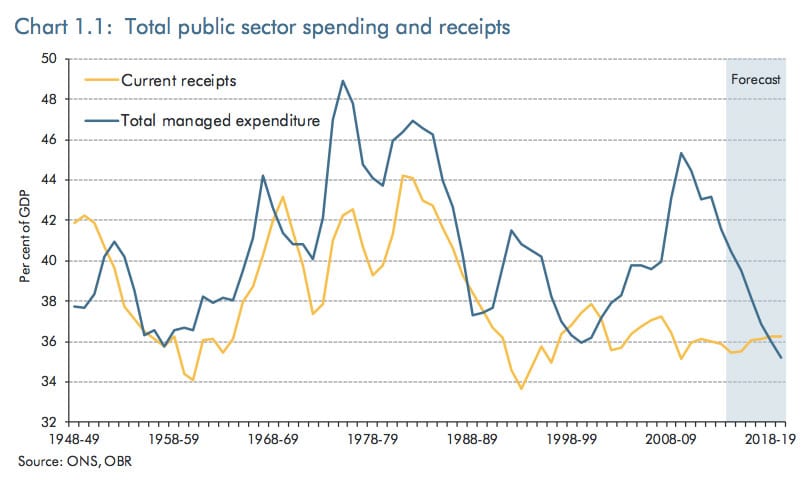
Even from the perspective of public spending for the welfare state, in the U.K. for example public expenditures as a percentage of GDP are below the levels from the late 1950s: https://www.economicshelp.org/wp-content/uploads/2014/12/gov.... And the whole economy is much more liberal than it was back then--British Telecom is a private company, etc.
At the same time income inequality is rising more or less everywhere [1] which is bad in several ways. [2] Those with capital are capturing more and more of the wealth, and we need to make sure that the growth in prosperity benefits all.
The numbers in [1] come from Oxfam, which gets them from a report by Credit Suisse. Here's what that report says:
Globally, the share of the top 1% has been rising since 2007 and is now close to the level in the year 2000 (45% versus 47%). But the share of the top 5% has shown little change, staying steady at 70–71%, and inequality lower down the distribution has declined. The share of the bottom 90% has risen from 11% in the year 2000 to 18% in mid-2019 according to our estimates.
So, essentially the top 1% is richer at the expense of the rest of the top 5%, not of everyone else. Billionaires eating millionaires, so to speak, not the poor.
No, this mentality causes over regulation.
You'll be hard pressed to draft laws that take all consequences into account. When players are activly searching for loop holes instead of trying to follow the intended spirit of the law, they cause more regulations. More regulations which consequences are hard to predict.
We should use social norms to punish people/companies who try to find "cheats" that bypass the spirit of the law, not praise them as clever, or just say, well, "they are supposed to maximize profits".
This only causes stupid downward spirals.
Freedom has a price, it's called responsibility and respect.
Subjective guidelines lead to subjective outcomes.
“Responsibility” and “respect” are vague ideas with no objective measure of what is allowed or not allowed. If society agrees we must stop something, the only way to do this is with specific, written law. Not shifting, vague moral platitudes.
Over-regulation is just another way to say “poorly constructed law.” We need to write better laws (or change the process for writing them if they are consistently mis-representing our intentions), not less laws.
Criticism is not misplaced if you feel these companies are not being "good citizens", nor is it really acceptable to excuse it away as "companies are supposed to be greedy and game the system as much as possible", and the public "outage" over these companies moves the democratic process along.
Ireland was motivated to stimulate their economy with these tax policies, which allowed exploitation of these loopholes in the first place. Finally they are closing, but with ever increasing regulatory capture, new loopholes will likely be found.
Arguably this a case of Tragedy of the Commons - with the Irish government doing what's good for its citizens, and the other governments not being strong enough at the time to police legislation of stricter tax laws for the greater good.
Governments can only be as good as their citizens contributing to it.
Those companies had a hand in forming those very laws.
They could have acted differently without giving up a competitive advantage, by lobbying for better laws for everyone involved, but they didn't.
Governments have to rely on external expert advice, and at its best, that is what lobbying is.
Google and co gave bad advice and that's what I'll hold them responsible for.
Not really, the government knew exactly what it was doing. That's why they complained when the EU said that they had to receive billions from Apple - they want to receive less, so that they can compete against other governments.
> It's always been a derelection of duty of governments when these loopholes exist in the first place. So it's great news that with enough publicity, democratically elected lawmakers felt the pressure from voters to fix this.
This sort of rhetoric does not help. Tax law is very logical, and these "loopholes" are often quite intentional and have a rational basis. Here, for example, the "double Irish" takes advantage of Irish tax provisions that encourage companies to relocate not only IP, but skilled workers to Ireland: https://en.wikipedia.org/wiki/Corporation_tax_in_the_Republi...
> Ireland's corporate BEPS tools emphasise job creation (either of Irish employees or of foreign employees to Ireland). To use Irish BEPS tools, and their ETRs of 0–2.5%, the multinational must meet conditions on the intellectual property ("IP") they will be using as part of their Irish BEPS tool. This is outlined in the Irish Finance Acts particular to each scheme, but in summary, the multinational must:
> Prove they are carrying out a "relevant trade" on the IP in Ireland (i.e. Ireland is not just an "empty shell" through which IP passes en route to another tax haven);
> Prove the level of Irish employment doing the "relevant activities" on the IP is consistent with the Irish tax relief being claimed (the ratio has never been disclosed);
> Show that the average wages of the Irish employees are consistent with such a "relevant trade" (i.e. must be "high-value" jobs earning +€60,000–€90,000 per annum);
One should hope most rules in Ireland are in touch with reality. You might ahve just given an example of that. The Double Irish with a Dutch sandwich is/was certainly not one of those...
There is no basis in reality for this entire construction. No OECD rules based arm's length, no proper transfer pricing, to defend this siphoning off billions of profits to offshore shells.
What about when those companies use their massive resources to lobby the government to make the laws in their favor?
Until our political system changes such that large amounts of money don’t exert such an undue influence on law and policy (which has been shown by a bunch of studies) isn’t that a bit of a chicken-and -egg scenario?
Thank You for writing this! It's crazy how far removed the idea of "where do the laws come from?" is from the discourse on "corporations must maximize profits".
There MUST be bounds on the imperative to maximize profits! Otherwise the corporation is obligated to overthrow the government and enslave all life in the universe. Even if they must do it legally, they can legally find ways to collude and overthrow the existing legal system.
Not at all costs. Maximizing shareholder value doesn't require maximizing profits if there is a better option that leaves the company healthier in the long term. Not being a cancer on society is a valid approach.
Profit maximization isn't as simple as you make out. If multinationals hadn't been as eager to optimize in the short term, there wouldn't have been as much political pressure to clamp down on them, and they may have maximized profits in the longer term.
Usually these things actually occur due to a race to the bottom, both in corporations - if they don't take the profits now, someone else will - and jurisdictions: regulatory arbitrage and competition occurs, and can make everyone worse off. For example, if one country gives tax incentives, then they all might be forced to; or if one country doesn't regulate pollution, then other countries may be forced to become lax. They're both collective action problems, and some kind of international agreement is generally needed to avoid the worst outcomes.
The EU is probably going to bring a variant of CCTB into effect eventually to avoid this kind of thing between EU economies. It won't be good for Ireland in the short term, but I think it's a better long-term approach, if it's done fairly.
When Ireland rejected by referendum the Lisbon Treaty in 2008, a series of clauses known as the Irish Guarantees were added. One of those guarantees is:
> Nothing in the Treaty of Lisbon makes any change of any kind, for any Member State, to the extent or operation of the competence of the European Union in relation to taxation.
Ireland holds a veto (as do all other EU countries) on any proposed Common Consolidated Corporate Tax Base, so the chances of a CCCTB as commonly envisaged being enacted is exactly zero.
Isn't it more like international relations working? US citizens didn't vote to end Ireland's tax loopholes, instead multiple countries pressured another country to level the playing field.
That's not generally true, and if it is it's not an excuse for anyone. Why are only corporations supposed to maximize profits? why are individuals not allowed the same kind of treatment to maximize their own profits? I never heard anyone say "hey, let's give everyone the right to a double irish burger".
it's nowhere near the <1% that big corp pays. that kind of tax is not even available to small fish by establishing a company in a low-tax EU jurisdiction, you can't go < 10%.
>This is fantastic news because laws were changed and that worked.
Um... the major reason that Google is not doing this any more isn't because Ireland changed their law, it's because Trump removed the tax on overseas profits they were avoiding from the US tax code.
IE, they don't pay taxes on those profits anyway when the money comes in to the US, so no need to hide the cash with loopholes in international law.
In fact, Google probably has more money overall this way because they can spend less for accounting.


This is fantastic news because laws were changed and that worked.
The criticism towards Google, Apple etc. for minimizing their tax burdens has always been misplaced. Corporations are supposed to maximize profits. And governments are supposed to collect taxes in effective ways.
It's always been a derelection of duty of governments when these loopholes exist in the first place. So it's great news that with enough publicity, democratically elected lawmakers felt the pressure from voters to fix this.
In other words, this is democracy working -- which is always nice to see.