I have a $600+ keyboard so I'm a part of this hobby. However, only a part of this can be explained by the expense of manufacturing at a small scale. The hobby fully embraces the drawbacks of the small scale and intentionally does nothing to try to improve it because the exclusivity drives prices up to an insane point.
A typical group buy for a popular case sells out in minutes or days time after time. Clearly some of the exclusivity is artificial.
An aluminum case that costs $300 is often 99% as nice as one for $1000.
There are designers lauded as geniuses that make cases that are almost identical to generic ones. It might have some kind of logo or inlay or a different color of anodized aluminum. Aftermarket they'll be worth insane amounts of money.
And with keycaps pretty much the entire thing is artificial exclusivity. $300-400 aftermarket for a set of keycaps is not unheard of.
There's nothing wrong with any of this, but as a happy participant I have to say the diminishing returns show up hard and fast in this hobby. Its all about fashion.
My $60 GMMK, with 20 minutes of easy modifications, a $30 set of keycaps, and a $90 set of healios switches was the smoothest linear keyboard I've ever used.
If you want clicky, the same setup with a $30 set of Box Jade switches will get most people the best keyboard they've ever used. Mx blues feel like rubber domes afterwards.
Interesfing article that talks about some of this. I recommend reading it.
Why did I pay $600+? I wanted an Ergodox split keyboard with helios switches + backlighting, to see if my wrists would feel better, and I didn't think I was ready to build a kit that required soldering.
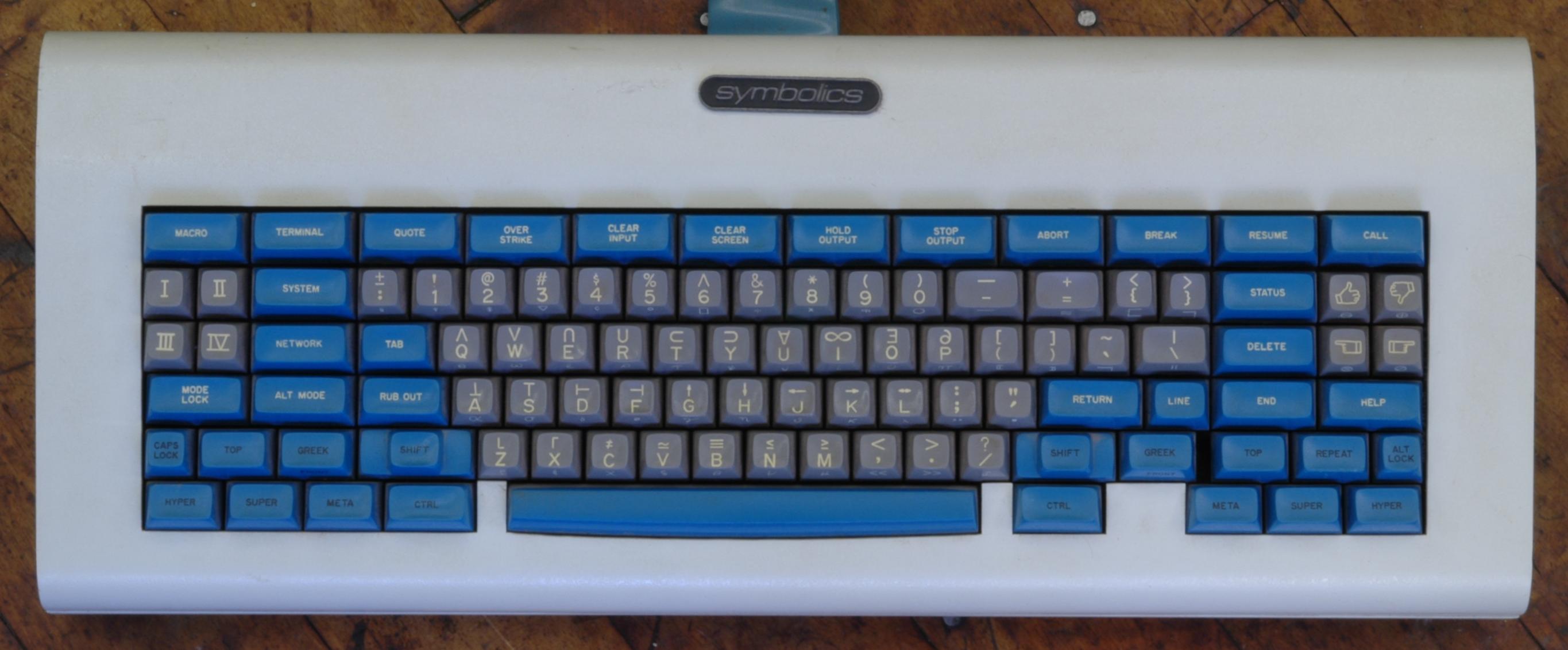
My Keycaps cost 170 of that. They are modelled after the Space Cadet keyboard from an old LISP Machine. This was uneccessary obviously but I liked them.
>the diminishing returns show up hard and fast in this hobby.
Of course that's true with lots of things. Cameras, audio equipment, video gear. Whenever I go into B&H Photo in NYC I'm always struck by how quickly the prices go up as you transition from pretty serviceable amateur gear to the pro stuff.
Well, the pro stuff is a little different because on one hand it's being purchased by people as part of a business... I never wanted a high-end video camera, for instance, because I've never wanted to keep that capital equipment working as often as it takes to pay for it. But if you can keep the equipment busy then spending $2K/channel for wireless audio transmitters or something makes more sense.
On the other hand, the farther you get up into production trades the more money is riding not just on your performance but on the performance of the people that are relying on you.
If I'm making a short film with my buddies for fun and I get a technical problem that prevents to director from monitoring the shot on a screen, oh well... if there are 30 people in the production and everyone is held up for 5min, that gets really expensive fast.
Depending on what you do with the camera, it's actually worth it though - at least for the initial amateur->pro jump.
Better/faster autofocus (usually), fully weather-sealed body (!), larger sensor (depending on what you need), dual-native ISO, etc etc
Plus other features that are technically still convenience, but can matter a great deal to a pro.
- Example1: Panasonic G85 has a couple reconfigurable buttons, but on the GH5 nearly every physical button can be configured to whatever setting you want.
- Example2: Dual memory-card slots for instant backups (some prosumer cameras only have 1 slot)
However, I agree that many salespeople will try to sell pro gear to a hobbyist when they really don't need it.
Seems less like diminishing returns and more like mass hysteria at this point. The only people I personally know of who are as detached from the rest of the market are those guys who collect Telecasters.
Also vintage synthesizer collectors - although that market tops out around $150k, which is cheap compared to the most expensive one-off Steinway Grand piano models, which go for between $1m and $2m.
I think there's a difference between "enthusiast market segment" and "investment commidities". Also even Yamaha grand pianos aren't typically purchased by individuals. More like venues, etc. AFAIK most of those prestigious Steinway models wind up in the lobbies of luxury hotels. Point is those things justify their prices in a way that $1500 keyboards don't.
But honestly I'm being cynical for no reason here. Those guy can spend money on whatever makes them happy. I am in no place to judge.
I'm on the hobby as well and I agree that the article reflects what we're seeing as of today, and even though I don't agree with the Vickrey auction from a buyer perspective, I do agree it's amazing for sellers since what they found is that a few people are really willing to go above and beyond in terms of money for a kit.
> My Keycaps cost 170 of that. They are modelled after the Space Cadet keyboard from an old LISP Machine. This was uneccessary obviously but I liked them.
There's a bunch of extra function keys that extend the modern standard of CTRL-ALT-DELETE and supposedly enabled 8k command combinations that were useful for lisp machines. However, the later versions of them didn't have the same color scheme and dropped many of the additional keys for simplicity.
there will probably be another edition eventually but as someone still somewhat noobish to this hobby i've heard lots of people are ok waiting a year or two for a new group buy to start for a specific set. If you want one now keep searching /r/mechmarket for "space cadet" and make sure you look into the different kinds of sets. Mine was $170 with shipping from europe, but there are less keys on my ergodox keyboard and the set was made specifically for them. A full set is probably somewhere between $200-300. I think I've seen them for the low end of that but I'm not sure. If you don't have to have something identical, there's an SA profile set for $100 that's just blue/gray without the special characters you see in the photos. You'd have to do some googling to make sure the sa profile fits on your keyboard though. Usually they will but sometimes people have issues so I'd research:
This is a chinese site, but very reputable. There are other places that stock the same set:
> My $60 GMMK, with 20 minutes of easy modifications, a $30 set of keycaps, and a $90 set of healios switches was the smoothest linear keyboard I've ever used.
Wow. Thank you.
I flirted with the "mech" community for a while a couple of years ago, and ended up with two boards:
A KBParadise V60 with Gateron Browns that I use as my primary keyboard for my desktop. That's mostly a gaming machine for me, but I do code on it quite a bit.
A bluetooth keyboard with low-profile Gateron Blues that I used with my iPad 6th Gen for coding (I use Blink to SSH/MOSH into a VM). That was a good keyboard but the feet broke off, then I upgraded to an iPad Pro and the Apple keyboard cover. It was collecting dust, so I gave it to my 11-year-old.
The GMMK looks like exactly what I was really looking for, for desktop use. I've got some research to do :)
By way of warning, GMMK uses a proprietary keyboard layout editor that only works on Windows (I tried running it in WINE and got nowhere). If editing your keyboard layout in firmware is important to you, I would recommend the Massdrop CTRL (TKL size) or ALT (67-key), which are similar keyboards with hot-swappable switches that run QMK firmware. (In addition to changing the backlighting colors and basic remappings like capslock to escape, QMK lets you do interesting things like add layers, or have a key behave one way when tapped and another way when held down and used as a modifier.) But if you can take care of all your layout needs in software, the GMMK is a great keyboard.
I run Windows 10 on my desktop at home when it's in "gaming rig" mode, but ArchLinux when I'm hacking on something. I have Manjaro on my personal laptop and macOS on my work laptop. Firmware mapping is definitely a requirement for me.
In fact, my experience is that what firmware a keyboard uses isn't always clear. My KBParadise V60 is almost perfect for me. I'd like a numpad sometimes, but I can always get an external one. The bigger problem is that keymapping can only be done through some DIP switches on the bottom or via flashing the firmware. The firmware isn't open source and is fairly obfuscated from what digging around I've done on it. the arrow keys are mapped to a cross arrangement on the right side of the keyboard, and I'd much prefer to use hjkl. I've not found a reasonable way to do it on that keyboard that doesn't require configuring it on every device I use.
Am not in that league, my main board is a Ducky Shine 3 TKL, but even dabbling into that world, I bought the Cities collection of spacebars for $50.
I find the niche fascinating, and regularly think about selling keycaps as a sideline - definitely agree with the notion that a lot of the designs people crave are rather quite simple. Or very similar to off the shelf ones.
Fashion is the interesting one, since the keyboard is one of the main interaction points for pretty much all knowledge workers today, it'll only continue to grow as a market (which might lead to more downmarket options?)
I think we'll see it grow. I started collecting old and new fountain pens a long time ago before it started to become a thing again. I've slowly watched that turn into a decently sized niche hobby. There are thousands of quality modern options available immediately. Its in a far more advanced state than the keyboard community, but I'm sure we'll get there.
Have you ever tried the "Falcon" Z-77 keyboard? It's been rebranded/knocked off by several Chinese manufacturers (different brands all have the same distinct falcon logo in the top middle of the keyboard) and is available on Amazon for around $30.
I bought one (the HUO JI version) after encountering several reviews from folks saying it compared favorably with their $100+ boards. I'm quite happy with it, and it's hard to have any idea if I'm missing out on anything and, if so, what I'm missing out on.
There are different shaped keycaps, like different profiles. I don't really understand that yet, I have some made specifically for an ergodox style layout, so they probably have slight differences.
I'll give a few recommendations, cheap and expensive.
First thing you should know is most of the expensive sets are abs, but abs eventually gets shiny and PBT does not. The material itself doesn't really dictate the quality beyond that. Some people prefer the naturally more textured feel of PBT and some people love the smoothness of ABS. I can tell my GMK abs keycaps that I spent $170 for are more lovingly crafted than my $30 PBT pudding caps or my other set of white backlit caps that cost around $40, but when typing on them I honestly couldn't say I have a preference.
Some people find no-name chinese sets that are made of good, thick plastic that are almost comparable to more expensive sets. Generally thicker keycaps are better made.
In general though, for the real high end stuff, a company called signature plastics and another one called GMK make most of the sets. They are about $100-200 in group buys. They sell small run sets on a bunch of different websites. The way you buy them is basically keep watching /r/mechanicalkeyboards or /r/mechmarket for a while until there's a group buy for one you like, then you put up money. There are some of these sets readily available on a bunch of different vendor sites, but they change all the time because of the limited nature.
Basically what you are paying for is double-shot abs or whatever other plastic they use, basically there's an inner layer and outer-layer melted together in a way where for the inner color only the character shows through to the top. It makes the keys last pretty much forever without the character wearing off (contrast this with my 2016 alienware where the WASD started wearing off in 2 weeks).
There are cheaper sets that are double shot, but there are less options for color and there's a small difference in the fit and finish. You can get a decent set of backlit keys for about $30. You can get a slightly better set for $40-60, and then there's the $100-200 sets that while, aren't a life changing experience to type on, have more options for how they look and they do have a high level of craftmanship that you can really only notice when you are inspecting the inside/outside of the key before you install it.
Some people obsess about the perfect accuracy and design of the individual characters on the keys, but I don't find that to be a big deal, but the more expensive sets do a better job of this.
As to what you are missing out on? Well, my first kit was a solid aluminum case and I filled it with a layer of some rubbery heavy stuff that I can't recall the name of, but the end result was a keyboard that's like 5-6 LB and it feels absolutely solid and absolutely amazing to type on. It was about $300 with a cheap set of keycaps. My newer more expensive one has a plastic case but I bought it for ergonomic reasons. Plastic cases can be very high quality though (this one is) and feel very good. However, if they made a version of this out of a solid block of aluminum like they do with more traditional keyboards, I would like to get one because there's still a noticeable difference in solidity and quality.
This is one of the cheap sets I liked. Its sold through but it pops up every once in a while, if you don't want to wait I think amazon has an almost identical set that could very well have even been made in the same factory for a different brand:
I encourage you to check out the mechanical keyboards subreddit's sidebar, there's a ton of information for helping people pick stuff out, that's how I got into it.
As a complement to phaus's excellent comment, I'd like to talk a bit about keycap profiles. The two main categories are cylindrical and spherical profiles. Almost all off-the-shelf keyboards have cylindrical profile keycaps on them by default -- essentially, it's as if a cylindrical chunk has been removed from the top of a flat keycap. OEM profile and Cherry profile are the two most common cylindrical profiles (the keycaps that come with most off-the-shelf keyboards are OEM profile). A spherical-profile keycap has more of a fingertip-shaped divot in the top (SA, MT3, DSA, and XDA are the most common spherical profiles). I personally find spherical profiles more comfortable than cylindrical profiles, so you may want to give them a try, but if you're happy with your current keycaps then you're probably not missing much.
The other major factors that describe profiles are height (hi-profile keycaps are taller than low-profile keycaps) and sculpting. With a sculpted profile, the keycaps on the top rows of your keyboard will be tilted towards you, the keycaps in the middle will be flatter, and the keycaps in the bottom row will be tilted away. Many people find this more comfortable than a flat profile (keycaps from any row of the keyboard are shaped the same), but others find flat profiles feel equally nice, and if you're using a layout like Dvorak or Colemak it's easier to switch your keycaps around to match (with a sculpted profile you'd have to buy an entirely separate kit with the alpha keys in the correct location). Hi-profile keycaps will be taller and, if they're sculpted, are generally sculpted more dramatically sculpted than low-profile keycaps. Sculpted keycap shapes are generally described by row number, with Row 0 or 1 used for the F-row and Row 4 or 5 used for the spacebar and modifier key row. (Numbering systems are not standardized, but R3 should always refer to the home row.)
Of the spherical profiles, SA and MT3 are hi-profile and sculpted (except for a few SA sets, which use all-row-3 keycaps and are therefore flat), and DSA and XDA are low-profile and flat. Low-profile sculpted spherical sets are rarer -- MDA profile was recently developed to help fill this niche, but you will have trouble finding an MDA set outside of group buys.
In terms of actual recommendations? Budget-priced spherical sets are unfortunately thin on the ground; they haven't really left the high-end group-buy-only enthusiast market, whereas there's a lot of cheap OEM profile sets with a variety of aesthetics. I own and like the Matt3o Nerd DSA set [1], which is currently in stock and costs $50. (Signature Plastics keeps some DSA sets in stock on pimpmykeyboard.com, but they're all $80-$100.) For a sculpted set, look at Maxkey SA sets on kbdfans.com (also priced at around $100, but it's a slightly better price than Signature Plastics' SA sets).
the boards and caps are nothing compared to artisan keycaps.
i have traded countless things to acquire keycaps that would sell for $250+ each. one keycap! brobot caps are especially rare and i frequently see people buying them for $500 each
i actually think artisans make sense to be so expensive since there is a level of artistry and rarity that most boards do not have. some of the rare korean boards are super rare too though and easily sell for $1000.
You've got me curious, what makes a particular keycap sell the prices you quote?
I can understand how valuation tied to rarity, but people paying ~$500 for a single cap implies that there's significantly more to it than scarcity. I know that if I try to search for an answer I'll get a bunch of cruft given my lack of knowledge of what question to even ask, so I'm hoping you can provide some background for a n00b :)
Artisan caps are a whole different thing. Basically the idea is that you get a fancy looking keycap that might be a little sculpture cast in a clear resin or even something 3d like a metal fist of thanos, and you replace 1 or 2 keys on your keyboard with it like an accent decoration.
Frequently people do it with the escape key and the space bar. They sell out fast and for certain designers I've seen the prices go up from $70 during the group buy to hundreds.
Here's one I wish I got so I could keep and use it. I missed out though and I refuse to pay $400 for a space bar.
It’s basically a piece of art. If you want to sell it to a private equity banker you put it in a gilt frame. If you want to sell it to a Facebook machine learning engineer you put it in a space bar form factor.
It's totally reasonable and possible to get a beautiful aluminum case for well under $200. I was able to get a "b-stock" Tofu HHKB[1] from KBDFans for less than $100. My very plain GMK White-on-Black keycaps cost more than that.
This sounds a bit like the custom bicycle frame builder phenomenon as well. Well-known builders/shops can have years-long wait lists and their builds will go for 2x, 5x or 10x the cost of a top of the line mainstream model - 10s of thousands of $$.
Granted each one is built by hand so the artisanal craft is easy to appreciate.
But exclusivity is there, because these shops are building less than a dozen bikes per year. If you got your hands on one, wow it will turn heads when you roll up to the bier garden at the CX race.
yes but its only been a couple months with that setup, I think having the ability to tilt each half so the inner side is higher than the outer side has helped my right wrist's tendonitis, but it could be because the tilting forces me to keep my hands off the desk to reach the keys, which is the supposedly "right" way to type, wrist rests help some people but you're still supposedly putting stress on your joints when rested.
If I had the discipline to keep my hands up with a regular keyboard I might have the same results.
Another thing to keep in mind is that it will take longer to tell for sure my wrist pain comes and goes.
> outer side has helped my right wrist's tendonitis,
I don't have tendonitis, however last week I was typing with the top of the keyboard much lower than the bottom and there was a feeling of relief in my hands. Just putting this out there.
I believe some of Microsoft's Ergonomic keyboards are highly regarded. I didn't try any of them. Not mechanical but I hear good things. Some of them seem to have a similar tilt to mine. Its not adjustable though and the ergodox folks say you should adjust regularly (I really don't though and I imagine most people don't).
The other big difference is that while the keyboard is split, it is still one piece whereas mine is actually split.
And finally, the ergodox-ez is ortholinear, so instead of key rows that are staggered, the rows of keys are mostly straight vertically, which is supposedly more natural.
At $40ish dollars, it might be worth trying one of the microsoft options.
My keyboard could have been purchased for about $300 without backlighting. It comes with a bunch of different options for the switch, I just swapped mine out (the sockets are hot-swappable so no soldering). I paid more for backlighting because its also got up to 32 programmable layers and you can assign a different color so you know what layer you're on.
There are some slightly cheaper mechanical options. There's a recommendation threat / question thread in /r/mechanicalkeyboards on alternating days where people might be able to help you find something cheaper. I don't know everything so I might be missing a great option for you that doesn't cost a fortune.
One last note, they are not much harder to produce, its just that no one is doing it at scale yet. They are still trying to find the perfect design. Ergodox is one version, there are lots of other split keyboards like iris, artreus62, etc. I think the ergodox is pretty good, but people with small hands might not be able to hit all of the buttons. There are 6 buttons per thumb. Honestly, if I try to use any but the bottom 3 per thumb I have to move my hands significantly, but I assign those to stuff I don't do often. There are other people making smaller keysets, or changing the position/layout to optimize for their use case. If anything ever definitively catches on we might see a mass produced version.
I use split keyboards, and for me I can't go back.
I'm able to reposition them so that I sit up straight and no longer have my wrists cocked at a weird angle. The ability to move them throughout the day means I can change where each half is and how angled they are depending on how i'm sitting (leaning back i'll move them more parallel, sitting forward i'll angle them more "outward", etc...) I also "tent" my split keyboards, so they are at like a 15 degree angle with the inside being the "tallest".
That alone have stopped the carpel tunnel pain I was starting to get while using "traditional keyboards".
But aside from that, the crazier "custom built" keyboards tend to run firmware that allows pretty insane customization to the keyboards which I genuinely can't see myself ever going back. Things like being able to make a dedicated key to commit my work in my editor, what I call "physical bookmarks" which are keybindings that will open websites or apps on my PC, and being able to move around the keys and add layers for various things (my left-alt key acts as left-alt when held down, but presses escape when tapped).
It does come with it's drawbacks though. I have a hard time transitioning back to a normal qwerty keyboard now, and that means I take my split keyboard with me when I travel if I'm expecting to use the laptop significantly. It's not that I can't, but that my muscle memory is really ingrained now and I end up making a lot of mistakes.
$30 is going to be really hard to find a split keyboard for, but if you are willing to get your hands dirty and do some soldering and flashing of components, you can pickup the parts for a "DIY" keyboard kit for probably around $100 if you do your homework. Something like [1] is about $20 for the PCBs and diodes, $20 for the mounting plates, and then you'd need to find some cheap-er switches and keycaps as well as 2 ~$9 controller chips. It's not off-the-shelf for that cheap, but it's doable.
amazon has them too but I don't want to keep posting links to stores like I have been because I don't know if it violates the rules and I'm certainly not trying to sell anything.
search box jade switches and you should get something.
At my first job I spent two years coding on a Hello Kitty keyboard. First meant as a joke for newcomers, I got so used to it that I didn't want to change it. I finally gave it up when I switched from a desktop workstation to a laptop.
Not using a Hello Kitty keyboard at work, but a pretty old IBM one that came with the hand-me-down workstation. I think it has to be at least 20 years old and I would be surprised if it cost more than $20 when new. I've went through 4 computer upgrades that came with new keyboards since, but I hated all of them. This one works and doesn't give me RSI, so any change is a risk as far as I'm concerned ;-)
Just in case this strikes anyone as dismissive, I too sincerely miss the old, beige keyboards that used to come with things like the old IBM, Tiny, MiTac, and Amiga brands I scavenged as a teenager. And those things were _robust_ - you could strip them down, soak them in detergent overnight, and have them good as new the next day without key caps falling off or the space bar sticking.
Those keyboard enthusiasts are in fact obsessing about the very same keyboards you mention, like the IBM Model M. One of those in good condition can be sold for quite a bit of money.
I had no idea :D I just thought they were exceptionally robust, and - ironically - cheap as chips at the time. Now that I think about it, yes, the term "chiclet" clearly contrasts with those older models. I have quite a few buried somewhere, might be time to break out the detergent again ;)
IIRC - the Model F keyboard of the old XT was one beast. I used have an XT I rescued from the trash; that thing had a solid aluminum case and weighed a ton. I love my Model M keyboards and my Unicomp - but I would love one of those older keyboards.
The feel of the model F keyboard (at the XT we both have) is unbeaten to me. Just wish I could get it in a _normal_ layout. I looked at the new model F F77 / F63 stuff just today sorrowing that I could not buy a 101 key layout at all.
Unicomp keyboards are great, they get too much flack IMO. Yes, they seem to be coasting at times, but I'd rather them coast than be gone.
Yes. They used buckling spring switches. Different from Cherry MX's. I think there are modern versions but IMO the way to go is what you suggested, keeping an eye out for a good deal on a real vintage one.
They're still made...
Unicomp ( https://www.pckeyboard.com/ ) bought the equipment ( from IBM?) and makes 'original' buckling spring keyboards now. They also have some nice 'upgrades' for them like USB connectors (ps/2 connectors can be hard to find now... )
You don't have to miss them, go on ebay, there's an entire hobby around vintage keyboards too. You can get adapters that enable you to use them on a modern system. Those things were built like tanks and sometimes you can get them for a good price.
Some of them are worth hundreds, but people still find them all the time at flea markets and yard sales for a few dollars.
If you dig around on Ebay, you'll find a ton of various kinds of Model M buckling spring keyboards for fairly decent prices; usually starting at around $50 USD. You might have to do some cleaning, but that's fairly easy.
You'll also find a ton of "specialized" Model M and other IBM keyboards that were designed for certain tasks - tons of extra function keys and strange layouts.
What you have to avoid (or look for) is to make sure they aren't the "silent rubber dome" kind - there were many Model M keyboards that used cheaper (but quieter) switches. Or that might be what you want. They are still (usually) good keyboards with a lot of life left in 'em - but if you want the real sound and experience, then buckling springs are where it's at. I haven't been able to find another kind of mechanical keyboard outside the Unicomp that comes close (and the Unicomp is a identical beast - I own one and two other original Model M keyboards - they all feel the same).
There are also a lot of different kinds and makes/models of the Model M - and then you have the whole Lexmark series of Model M (and the various different IBM logo labeling).
One of my Model M keyboards is a bit unique from what I understand: It's a Lexmark, with the blue tilted IBM logo in the corner, but it has the flow-thru slots and tray under the keys. From what I understand, Lexmark supposedly didn't make the flow-thru model. I don't know if mine is a unicorn, or if the collector market is confused or what; I suspect the latter.
Oh - one other thing: Connectors. The Model M was made with a variety of cable end connectors, and is another thing you have to look out for. You may have to rewire or buy/build an adapter (and it wouldn't surprise me to find that there were also different controllers in the keyboard itself, not all being able to communicate with a regular PC).
that's different. Those are nice but there's a company called ZealPC that makes a few different models of switches. They don't have to be purchased from his site directly, there are a few other places that have them.
Healios is the name for their silenced linear switch. Its the quietest and smoothest linear switch I've ever tried. They are about $1.50 a switch though, mx's are like a quarter and Box Jades are about 35 cents. IMO they are worth it but some people try MX silenced reds and like them better at a fraction of the cost.
I bought a switch tester with 25 different switches that I thought I might like and then used it to decide what to get.
Healios is sold out on the company site right now but the 67g version of these (roselios) is identical IIRC. I have a mix of both on my keyboard. These were just done with a different color plastic stem for a charity event: https://zealpc.net/collections/switches/products/roselios_sa...
There are other places that likely have healios in stock.
Some people still prefer blues, I might be slightly exaggerating. Not everyone wants a key as hard to press as a box jade but I love them.
When they did a survey of /r/mechanicalkeyboards the most common favorite is Brown, Blue was up there too.
/r/mechanicalkeyboards and /r/mechmarket area great place to go to further investigate the hobby. Be warned I can't be held responsible for anyone's wallet.
Are there any switches that come close to the feel and sound of buckling spring (aka Model M) switches?
I haven't been able to find anything like that; even the stiffest and clickiest and tactilest cherry key switches I've played with don't come close to the feel.
I'm not sure where Unicomp gets theirs - likely make them in-house would be my guess.
I currently own two original Model M keyboards, and one Unicomp Classic USB (it was given to me as part of my severance package from a former employer because nobody else wanted it after they downsized me - so they stuck it in the box of my things they shipped back to me).
But I can't find keycaps for any of those that are "all black" (which I'd like for my Unicomp - which is a black case design - but greyish keycaps).
So a "standard" switch, with keycaps - but with the same feel, etc as an original buckling spring switch - that's what I'm looking for (under-key blue glow to match my case effects would also be a nice thing - but baby steps).
I think there may be modern buckling spring key switches.
Most modern mechanical switches have their own sound. MX Blues and knockoffs sound like MX Blues, the Box Jades I described have a really really nice clicky noise and IMO the best tactile clicking feeling. You could try them next to a buckling spring keyboard and you may or may not like the buckling spring feeling and sound better.
I've used both vintage buckling springs and box jades and I like Box Jades better.
They sell switch testers with lots of different switches on them, if you want something really obscure like a modern buckling spring you might have to buy a few of the switches separately, but then you could test them alongside the others.
I learned to type on manual typewriters, so I like a _heavy_ switch... Box Navy Blue, Box jade, or sages are my current favorite. Cherry Green just wasn't tactile or clicky enough for me.
Not hard to do, and it changes the sound/feel of them in a way a lot of people appreciate.
P.S.
I second the GMMK ( https://www.pcgamingrace.com/products/gmmk-full-brown-switch ) as a good way to try out switches and keycaps. The board is fairly cheap, nicely built, and has hot-swap switches that allow you to try various switches without soldering...
It sounds like a lot but I am not a particularly handy person and I did it right the first try. I just had to use a brush to remove a little excess lubricant on one of the stabilizers because it was sticky. On my GMMK keyboard where I was going for silence, the different before and after the stabilizer mods were incredible. It sounded cheap and rattled a lot, even though the keys still felt good. Afterwards it was near-perfect.
There are two primary things that make noise. Some noises are good and some are bad. If your keyboard makes rattling noises when you type, that's considered a bad noise and likely caused by stabilizers. Stabilizers the the extra things you see under the larger keys on a keyboard like the spacebar and shift. Different keyboards have different numbers of them.
The other thing that makes the noises are the switches. Some people want clicky noises, some people want silence. The case and the keycaps can alter the way your switches sound too. If you want it quieter there's some rubbery sound-dampening material you can buy to line your case with, some people use other materials. Basically the more empty space there is in your case the more potential for noise.
So if you want a silent keyboard, you use that lining material, you use linear switches that are designed to be silent, or you buy regular linear switches and silence them yourself using little rubber rings. Definitely mod the stabiliizers by taking them apart, cutting these extra little plastic feet off like the linked article, optionally placing a small piece of cloth bandaid under it, and relubricating it after wiping the original lubricant off. Some people go so far as to open and lube the switches, but that's not a 20 minute job. Everything else I described is fairly quick, but it will probably take more like an hour the first time you do it. Its easy though. As a further step, some people buy better stabilizers, authentic GMK stabilizers that screw into the circuit board. However, when I modded my GMMK I used the stock ones. Some people don't like them but it seemed decent. My space bar was kind of noisy but I skipped the bandaid mod for this which would have likely helped, otherwise it was super quiet.
If you want a clicky keyboard, you buy clicky switches. You still want to get rid of the rattle noises so you will still need to clip, lube, and optionally do the bandaid mod for your stabilizers, upgrading to better stabilizers if you want to do it. Lining the case is more optional. If you do want to line the case, its always a good idea to research whether there's even enough room in your specific case to do it. I did not try it with my GMMK.
There are some people that get into extreme keyboard modding. Some people try to stick little pieces of foam in the hollow parts under-neath the keycaps to minimize noise, I haven't gone that far.
Here's an example of what's possible to with a little bit of learning. Note that this guy is one of the best and he may have also used other techniques, there's probably a full stream of him making this keyboard or one similar somewhere online.
Wow, thank you very much for your extremely detailed answer. I'm looking to invest a little bit in things that I use every day (keyboard, chair) and your original post stuck out because you acknowledged it's possible to have a nice mechanical keyboard without breaking the bank.
There isn't? Deliberately understocking so that some of your users miss out and the rest have to pay more seems like it's all bad for the users, even if it's making money for somebody.
I can't see how there's anything wrong with deliberately doing a small production run of something, because if it undersells you're going to lose a lot of money.
Fundamentally these aren't utilitarian items, they're luxuries, and the market behaves as such. Limited editions are totally normal in the art world.
This problem has been thoroughly solved in the mechanical keyboard community with group buys. Take pre-order payment in advance over several weeks and Bob's your uncle, no underselling.
> The hobby intentionally does nothing to try to improve [the drawbacks of the small scale] because the exclusivity drives prices up to an insane point. [...] There is nothing wrong with any of this.
If it's still worth it for you, that's fine. Or if you figure that selling a few blinged-out "designer" models at ultra-premium prices helps support the main product, or if you don't care either way because you don't buy the top models, or you admire the designer's business savvy, or any other thoughtful reason that hasn't occurred to me, that's all fine.
But describing that situation I quoted above, and saying "there is nothing wrong with this," is pretty debatable! And I'm getting downvote-bombed for politely debating it. Hacker News is weird sometimes.
Maybe downvotes cause the MK group thinks it's fine. Then you, with a cursory look at the group, state their happy place is "all bad" - and demonstrate a mis-understanding of the MK market forces - which had already been described.
Seems there's a pretty obvious argument why artificial scarcity purely for financial gain is wrong, assuming the goods provide a benefit of some kind (and if they don't then there are ready arguments not to sell them at all).
It seems pretty obvious why it isn’t wrong in this case and that is that there is no general shortage of keyboards. Someone buying one of these isn’t going to deprive anybody else from buying a keyboard for their computer.
I spoke poorly, I meant there's nothing wrong with people spending money on expensive things simply because they like the way they look/sound. I don't like predatory pricing. Limited Editions are OK, but when every single product is a limited edition designed to milk every last cent out of people I have an issue with it.
Although, if its gonna happen, I am very happy that its happening to a luxury product and not something my friends and relatives that make less than a 3rd of my annual income desperately need to survive.




A typical group buy for a popular case sells out in minutes or days time after time. Clearly some of the exclusivity is artificial.
An aluminum case that costs $300 is often 99% as nice as one for $1000.
There are designers lauded as geniuses that make cases that are almost identical to generic ones. It might have some kind of logo or inlay or a different color of anodized aluminum. Aftermarket they'll be worth insane amounts of money.
And with keycaps pretty much the entire thing is artificial exclusivity. $300-400 aftermarket for a set of keycaps is not unheard of.
There's nothing wrong with any of this, but as a happy participant I have to say the diminishing returns show up hard and fast in this hobby. Its all about fashion.
My $60 GMMK, with 20 minutes of easy modifications, a $30 set of keycaps, and a $90 set of healios switches was the smoothest linear keyboard I've ever used.
If you want clicky, the same setup with a $30 set of Box Jade switches will get most people the best keyboard they've ever used. Mx blues feel like rubber domes afterwards.
Interesfing article that talks about some of this. I recommend reading it.
Why did I pay $600+? I wanted an Ergodox split keyboard with helios switches + backlighting, to see if my wrists would feel better, and I didn't think I was ready to build a kit that required soldering.
My Keycaps cost 170 of that. They are modelled after the Space Cadet keyboard from an old LISP Machine. This was uneccessary obviously but I liked them.