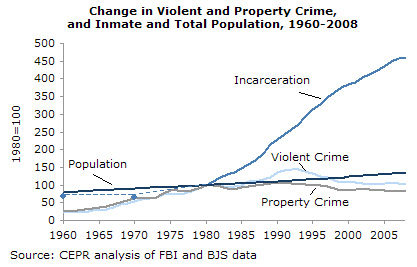
Stop throwing people in jail for "moral crimes" such as drug use, and we'd see a massive decline. Victimless crimes, such as contempt of court for not being "respectful" enough of a sitting judge, or the like should never send you to a cage either. One could make a massive list of the ridiculous uses of our criminal justice system, and sadly many don't see it as a problem.
Drug crimes cover only 16% of inmates in US state prisons [1]. It's higher in Federal institutions, but that's only about 15% of total inmates.
I don't disagree that many drug offenders probably shouldn't be in jail, but the US could release all of them and we'd still have the highest incarceration rate in the world.
How many started that way or their crime involved weapons/money that were involved in a drug operation? How many repeat or lifetime criminals were first created with a non-violent drug crime?
If it is non-violent it should not be something that locks you up ever as that is cruel and unusual punishment, outside the law that is abduction and locking them up in a box.
Jailing non-violent offenses costs the taxpayer and the individual more to no benefit. There should be payment penalties and temporary records for those that do repeat offenses, real rehabilitation, mental help, also job programs for them if desired. All of that would probably be cheaper than creating lifetime criminals.
Not just for non-violent drug offenses, when I hear about people stealing cars for instance and getting locked up it makes no sense. Insurance exists, and we want the criminal out working to pay that back not debt taxpayers 30k+ per year, it is a loss all around and compounding.
What is the average number of property crimes committed before a criminal is arrested and jailed? The crew that robbed my home hasn't been arrested for that crime. When (if) they are eventually caught, I want them locked up.
Would you rather they pay you back than cause 30k+ per year to the taxpayer. How about they are in a job program and earn it back for you and garnished wages until it is paid.
Also did you have insurance? Did it cover it? Do you need someone locked in a box for years because of it? Is it that level of crime? What if you have a son and he did it, would you want him turned into a lifetime criminal? Our current system is basically locking people into a life of crime and bringing criminals together to further spiral into it.
There's a difference between Jean Valjean stealing a loaf of bread to feed his sister's dying child and an organized crew which makes a living from robbing houses. The former is a great candidate for a job program. The latter already have their own job problem; it's just rather antisocial.
There's not enough jobs as it is, why should Criminals get jobs, when lawful citizens can't find employment? But I'll entertain your idea.
Say Jean valjean stole a loaf of bread to feed his family (highly unlikely), then let's make the punishment of his crime, to replenish that item by working (but not like labor camps of course). Jean would have to work on a farm, planting seeds, pulling weeds from the wheat field, in the hot sun along side illegal immigrants. That should be punishment enough right? But before he could return to normal American life, he'd first have to sign a promissory note to his allegiance with the Democratic party . Sounds like awin-win. Who needs food stamps? Ah so here we are, reducing illegal immigration while helping poor Jean recover himself. Let's send a letter to Congress.
I had insurance, it did not cover all of the losses. Assuming this wasn't the first house they robbed, there are many people who suffered losses as well.
I do have a son and I would be very unhappy if he started robbing houses. Because of this, I consider it my responsibility to raise him correctly. A concept that seems sadly out of fashion these days.
The things I'd like to happen are:
1) Reduce the liklihood that these people will commit further crimes
2) Discourage other people from robbing homes
3) Help you replace the things you lost
I'm not really familiar with the literature on this, but I'd guess there are more effective options than prison for all three of those.
I want them locked up, so they don't commit more crimes. Obviously the police don't catch every criminal that commits every crime. So catching them and locking them prevents them from committing more crimes.
I think he's getting at the fact that if they're in a cage they can't commit crimes while in there (sorta). Recidivism rates would suggest that prison doesn't actually do much to prevent future crime unless they're physically in the prison.
It reduces it 100% on the people that aren't let out again. Which suggests that we should be looking at life in prison, rather than shorter sentences if we really want crime to go down and we are conserned about them becoming hard-core criminals.
Actually though I think there is a mismatch - there are two groups here, those who made a mistake but are fundamentally good people (they perhaps have a drinking problem or a drug problem, fell into a bad crowd, etc) those should probably not be put in jail, but more a closed treatment center, put on parole, sentenced to community service, etc. The idiots who stole my wheel-caps probably belongs here, as would somebody who killed their spouse because they abused them - it is not okay, but it doesn't make them unredeamably bad people.
Then there are the people who are just scum, the [mum who goes out to drink, leaving her toddler at home](http://www.lohud.com/story/news/crime/2016/05/09/new-rochell...), the gang members, the people who commits rape, etc. Those just needs to be locked up, forever if possible.
It appear to me that both sides of this debate are only focusing on one of the sub groups and are trying to apply rules evenly, without first looking at the criminal. This will absolutely result in injustices, either by throwing a 17 year old in prison for life with out the possibility of parole for [killing her pimp](https://en.wikipedia.org/wiki/Sara_Kruzan) or releasing criminals who will go on to do more criminal acts.
I don't know that you're considering a couple things: 1. people are locked up not just to punish them since they committed a crime but also to keep society just that much safer from that criminal and 2. you assume most people have sufficient insurance to replace their stolen vehicle and that they have alternate transportation to get to their job or to pick up/drop off their kids. I know folks with liability only insurance that just barely scrape by and if they didn't have their car for just 1 day they wouldn't be able to do the things I listed.
Criminals do work in prison as well such as producing goods (various forms of apparel) or performing services (landscaping and picking up trash). Considering they're not entitled to minimum wage, their cost of labor is extremely low and one doesn't need to sell a given product for much of a high price at all to make a profit. That profit gets reinvested back into the economy in one form or another so I'd argue the taxpayers are getting most, if not all, of their money back.
Furthermore, those who resort to stealing cars seem to have decided they're not going to get an honest job and since the car-stealing business probably isn't very consistent compared to working a retail job then I'd argue they don't have the requisite history of pay that affords them the ability to repay their debt to society.
There are 200k federal prisoners out of about 1600k total. The fact that federal numbers are 50% drugs doesn't change the fact that the overall numbers.
If we let out our non-violent criminals, then the prison population will only be cut by half. The majority of people in prison are violent criminals.
Fines, repeated violations rise up the amount and possibly barring licenses, restraining orders, rehab programs, mental health, and more. Until it is violent there should not be an authority abducting and locking up someone causing tax payer dollars to be further wasted and creating more problems.
Fines? - People who steal or sell drugs, do it because they believe they can't survive any other way! Additionally, what if people cannot and do not pay fines? You have a recursive problem right? Are you gonna fine people who cannot pay a fine? Or would you like to add an amendment to your system to put people who cannot afford fines in jail?
Barring licenses? - Why do they need licenses? If they get caught, they'll just "pay" a fine right?
Restraining orders? - Why would they accommodate?
Rehab programs? - Isn't this what prison[0] is supposed to be? Or are you suggesting they can walk out at any time (including before being taken there)?
Mental health? - Isn't this just prison[0] with pills? Or are you suggesting they can walk out at any time (including before being taken there)?
Please don't misunderstand me, I respect and would love to see a better system. I'm even convinced you're on the right path. I just don't think its as easy as you seemed to state.
[0] Where prison is defined: "something that locks you up"
The alternative is locking them up and creating lifetime criminals.
We need to separate criminals and give them new communities to find worth in for the most part. Most people don't commit crimes because they want to. If you can separate them from the criminal element, find worth and independence, that is the solution.
I think putting them up with other criminals is like a crime university, it will be all they know. Prison is supposed to be rehabilitation but it creates hardened criminal elements.
Your better system is taking people and locking them up together and then charging the tax payer 30k per annum, even if they pay no fines they are still causing less budget.
There aren't any easy solutions but that is mostly wrong for non-violent and low level offenses like drug crimes.
This Norway prison has prisoners work on a farm/island as an example of a new community. [1] It has some of the lowest recidivism in the world. Sometimes people in poverty have never been treated like humans, maybe if you apply this to them then certainly a percentage would see worth. The other harsher ways are creating more re-offenders in the US system (the main problem of this article).
I'm not entirely convinced that it's the threat of punishment that stops criminals. Going on the criminals I know (crap evidence, I know), excluding the total psychopaths, what has stopped them is guilt for hurting people and/or wanting to be a better role model to their kids/siblings/younger kids that look up to them. All that the justice system seems to do is take away their ability to make legal income and years of their life.
For the criminals lacking empathy, I don't know of a good solution to preventing them from hurting people.
That statistic only targets drug crime (possession, selling, manufacturing, smuggling), but not the associated crimes like theft, robbery and prostitution, or burglary/forgery (e.g. to get "legal" drugs from pharmacies or Rx blocks from doctors).
When assuming similar numbers for the US, I'd rather think of up to 40% of inmates in due to drug-associated crimes.
edit: Also, violence and gun crimes should be counted to drug-related, if the crime was committed in relation to "turf wars" or similar gang activity... and furthermore, drug convictions usually make a person next to unhireable, which leaves the convict without legal means to earn money other than social security, which isn't nearly as comprehensive and extensive as e.g. Germany's system. This in turn leads to more drug-related crime... all of which could be avoided by simply legalizing the most common kinds of drugs.
I read an article the other day where police placed a bicycle unlocked in a public place, then watched it. Once someone took off with it, they arrested him. Since he didn't plea bargain, the judge gave him 3 years.
A couple things:
1. I would think either a fine or a 30 day sentence is more than enough.
2. I think it's bad for society in general for police to actively bait people into committing crimes.
3. That's about $150,000 of taxpayer dollars for a $100 bicycle.
4. Unrelated but important. In the US, it's legal for police to lie to you about your rights, what evidence they have, or anything really. I believe that is bad for society as well.
Bike thieves have no fear in most cities, even when it's a $500+ bike (that is, any bike not purchased at Walmart). That's not easy to replace for most people, even engineers. Locking up bike thieves is plenty productive.
We should simply lock everyone up, who could become a bike thief. If you have hands and legs, i personally find that very suspicious.
The problem is, that there is a strong retalitation instinct in humanity, to enforce group norms.That worked well in villages, but if allowed to be lived out produces ridiculous amounts of locked up people.
Whats even more disturbing is, how those locked up people are not allowed to be a productive part in society. They get hamster-wheelian-jobs in the prison industry, instead of continuing with there real jobs.
> 1. I would think either a fine or a 30 day sentence is more than enough.
What makes you think this will deter them from repeating the crime in the future?
For a drug addict in search of a fix, bicycles have high liquidity on the market, are easily stolen, and usually not caught. Drug habits are not easy to kick away.
Note that I am not saying that long prison sentences are an answer for this, just pointing out that a fine/30 day sentence will likely not work.
I think a prison sentence on someone's record will make them more likely to repeat the crime. With the criminal record, minimum wage, or close to, are the only options available.
Also, it's human nature to believe you won't get caught. If someone thought they were likely to get caught, they wouldn't do it.
Thirdly, what makes you think a 3 year sentence would deter someone from doing it any more than a 30 day sentence would? I'm sure the person didn't even realize stealing a bicycle carried a 3 year sentence. For deterrence to work, a person must know the punishment for the crime. Also, the 3 year sentence doesn't fit the crime. At some point, it becomes cruel and unusual. I think locking a person up for 3 years for stealing an unlocked bicycle that the police planted trying to bait someone into stealing it is cruel and certainly unusual. It's also pretty darn close to entrapment.
What if police left a penny on the sidewalk and arrested anyone who picked it up and locked them away for 3 years? How much different is that from the scenario I described? How about a quarter? How about a $20? What denomination would make 3 years and arguable entrapment acceptable?
Finally, we have a deterrence paradox. If the US houses the largest prison population in the world, why are there people still stealing bicycles? On the other hand, if crime is at an all time low, why are we still locking people up at an increasing rate every year?
> I think a prison sentence on someone's record will make them more likely to repeat the crime. With the criminal record, minimum wage, or close to, are the only options available.
What difference then does it make it if is 30 days or 3 years?
In other words, how is 30 days an improvement to the problem of deterence (though it is an improvement to the taxpayer)?
> Also, it's human nature to believe you won't get caught. If someone thought they were likely to get caught, they wouldn't do it.
Not necessarily, some people who know that with high probability they will get caught still perform crimes; drug addiction can be quite powerful.
At a first glance, I would think that substance abuse treatment/improvement in mental health facilities can help here.
> Thirdly, what makes you think a 3 year sentence would deter someone from doing it any more than a 30 day sentence would? I'm sure the person didn't even realize stealing a bicycle carried a 3 year sentence. For deterrence to work, a person must know the punishment for the crime. Also, the 3 year sentence doesn't fit the crime. At some point, it becomes cruel and unusual.
I agree here; this is part of the reason why I don't think long sentences are a good solution. But in my view, your proposed solution does not do much either to the problem of deterrence.
> I think locking a person up for 3 years for stealing an unlocked bicycle that the police planted trying to bait someone into stealing it is cruel and certainly unusual.
It's also pretty darn close to entrapment.
What if the police simply want to install a tracker, in order to investigate the possibility that the theft is being performed by an organized ring which regularly steals bikes, in which case a 3 year sentence could fit the crime? Standard bikes do not come with trackers; this will require active intervention.
See http://www.nbclosangeles.com/news/local/Thief-Makes-Quick-Wo... - here the "entrapment" was done by civilians. Sting operations by civilians are certainly useful in many parts of the world, e.g to expose bribery.
I fail to see why there should be a blanket "no to entrapment" in the case of police, but continue to allow it for civilians.
Personally, I believe entrapment by both civilians and police forces has its uses at times.
> Finally, we have a deterrence paradox. If the US houses the largest prison population in the world, why are there people still stealing bicycles? On the other hand, if crime is at an all time low, why are we still locking people up at an increasing rate every year?
I don't have an answer to this. On the other hand, in my view your proposals do not either.
>What difference then does it make it if is 30 days or 3 years?
Because a 3 year gap in your work history is much harder to explain than a 30 day one. Also, when someone runs a background check and sees that a hire was imprisoned for 3 years, they will think the crime was much worse than it was.
>Not necessarily, some people who know that with high probability they will get caught still perform crimes; drug addiction can be quite powerful. At a first glance, I would think that substance abuse treatment/improvement in mental health facilities can help here.
That's an exception that proves the rule. Drug addiction isn't rational thought.
>But in my view, your proposed solution does not do much either to the problem of deterrence.
I think prison terms as deterrence is an illusion. Prison terms as punishment which may have a secondary result of future deterrence is more likely.
>What if the police simply want to install a tracker, in order to investigate the possibility that the theft is being performed by an organized ring which regularly steals bikes, in which case a 3 year sentence could fit the crime? Standard bikes do not come with trackers; this will require active intervention.
You are simply adding complexity to the same immorality.
>I fail to see why there should be a blanket "no to entrapment" in the case of police, but continue to allow it for civilians.
Police can and do arrest you. There are privacy laws in the US against such things, or at least there were.
>I don't have an answer to this. On the other hand, in my view your proposals do not either.
As I stated earlier, I don't believe deterrence is the primary reason for sentencing. It's punishment for a crime.
I agree that leaving a bike unattended to bait someone to steal it isn't fair since there might be a non-insignificant number of people who wouldn't normally steal the bike but perhaps would rather ride than walk and would then feel guilty and ditch the bike a few blocks later.
However, there are also professional bike thieves who break into alcoves, garages, etc.; They also cut locks and/or beat up or knock down riders if they can't get the bike by waiting. My point is, not all bike thieves are the same and if someone didn't fit the profile of a typical bike thief then instead of arresting them, cite them. I'm sure most people who are not thieves but who stole a bike as a crime of opportunity would not do it again if it cost them as much as running a red light does.
Bicycles theft is basically a "free crime", almost nobody ever gets caught. This also causes serious issues to those who depend on the bikes to get to work (or even as their work). As such the penalties have to be absolutely draconian when they do get caught - in fact 3 years sounds lenient, we used to hang horse thieves.
Contempt of court is not a victimless crime. Nobody gets sent to jail just for being disrespectful--they get held in contempt for disrupting the process other people rely on to adjudicate their rights.
Lots of other ways to handle it though. They could:
- Have a “lose your turn” approach (toss your case to the bottom of the pile and keep moving the others through, until you cool down).
- Ignore you and restate the question/statement that preceded the contempt of court. If it persists, then escalate.
- Give a fine; $50 ought to dissuade most people from continuing to cause a problem.
In fact, they could do just about anything before sending someone to jail.
And heck, there are times in my career I wish I could have put someone in a box for being too disruptive during a meeting or something. Yet we don’t do that, in part because we’re supposed to be civilized. Maybe the “point” of contempt charges is to maintain order but it really just makes the court look like a spoiled child that goes way overboard when challenged.
You're arguing against a straw man. There is a lot that happens before someone gets held in contempt, and even then the usual solution is a fine ("$1,000 for every day you refuse to comply with the order") not jail time.
But the threat of criminal contempt is absolutely necessary. Judges have to be able to do things like get CEOs of multi-billion dollar companies to hand over documents or testify about things that could cost their companies a lot of money. They have to order construction halted on a multi-billion theme park to protect endangered frogs. Fines aren't going to get that done. The fear of being sent to jail will.
As a practical matter it almost never comes to that. And even when it does, it's subject to review like any other charge.
I'm sure in a country of 300 million people it's happened before, but I don't know of an actual example, and certainly it doesn't happen enough to register even as a blip in terms of the number of people in jail or prison.
People get held in contempt for refusing to cooperate with the legal process. Not turning over documents they are obligated to turn over, not testifying when they are obligated to testify, etc.
That hearing involved a defendant accused of murder who demanded a new attorney for frivolous reasons. His vulgarity was not just rude--he prevented the hearing from moving forward. That wasted time and taxpayer dollars and also delayed further prosecution of the actual crime. That's a terrible example of a "victimless crime."
Also, as far as I know, the "10 year sentence" was just bluster from the judge, who promptly self-reported the exchange and recused himself from the case, not to mention was publicly admonished for it by the court.
I don't know the statistics, but any basic definition of contempt of court gives the two main reasons: disobeying a court order, or being rude to court officials. Being jailed for disrespect is absolutely a major component of contempt of court.
(1) Contempt of court will never see anyone in prison. Prison (in the US) is only for those serving sentences of over one year. A contempt charge is not going to result in a guaranteed sentence of over a year. Six months is generally the outside, but even then only if you disregard any "purge" stipulations. Contempt sends you to jail, not prison.
(2) Contempt is not a "victimless" crime. It's not really a crime, but the court/judge is the victim in the situation.
(3) There is strong argument for "victimless" crimes to be punished more severely. They are the easier to hide as there is nobody around with a desire to report them. Drunk driving (absent an accident) is victimless but we punish it as we do to deter the legions me know are going undetected.
(4) Be very careful about throwing around the victimless label, especially in regards to drugs. Many a family has suffered horribly as one member is consumed by drugs. That nobody is bleeding in hospital doesn't mean there aren't victims.
For #4, how does the act of using a drug recreationally and responsibly cause any suffering at all to one's family? If I drink a beer, have a coffee, or smoke a bowl, how does that affect, say, my mother who is 3,000 miles away?
I have a feeling you're conflating use with abuse.
> Prison (in the US) is only for those serving sentences of over one year.
This is a popular conception of the prison/jail distinction, and it has some general connection with reality, but it is both possible to be in a "prison" with a sentence of less than a year, and to be sentenced to a "jail" for sentences of greater than a year.
Susan McDougal is a specific example which shows there is both criminal contempt-of-court and some of can happen as a result of civil contempt-of-court. Quoting https://en.wikipedia.org/wiki/Susan_McDougal :
> From September 9, 1996 until March 6, 1998, McDougal spent the maximum possible 18 months imprisonment for civil contempt, including 8 months in solitary confinement, and was subjected to "diesel therapy" (the practice of hauling defendants around the country and placing them in different jails along the way).[12] In her case, Susan was shuffled from Arkansas to "Los Angeles to the Oklahoma City transfer center, and then on to the Pulaski County Jail in Little Rock, Arkansas".
> ... McDougal's trial for criminal contempt-of-court and obstruction of justice charges began in March 1999. The jury hung 7-5 to acquit her for contempt of court, and found her not guilty on the charge of obstruction of justice.
Also, H. Beatty Chadwick was held in jail at the county prison for more than 14 years as a result of contempt of court.
A lot of repeat offenders are created when they can't have a real life after the first offense and double down on making a living out of crime. Someone who gets their first felony for possession with intent to sell might find that the least bad career option they have after prison is selling drugs. They when they get arrested the next time they have priors and they go away for longer.
This argument doesn't make any sense. What would be the reason for seeing more repeat offenders other than sending more people to jail in the first place? The statistic they're observing is a RESULT of prison growth, not the cause. Obviously they correlate, but without the incarceration rate going up first, this simply doesn't make any sense - the average # of prior offenses can't increase unless the rate of conviction increases first (and must lag by the average recidivism time), so average # of prior offenses is clearly not a leading cause.
"If the United States wants to reduce the number of people in our prisons, King said these results suggest we need a new approach."
When states and municipalities are no longer incentivized to have large prison populations and the same for law enforcement and making arrests, maybe we'll see a reduction in the prison population.
16% at state level from same source, over 50% at federal level. Probably 20%+ directly and up to 30-40% indirectly related, 1 in 5 to 1 in 3. That is lots and lots of people we are paying for to be somewhere that they maybe weren't violent to begin with but are now, prisons are a criminal making machine. They could be out, or in a program, making a net benefit paying it back rather than a total loss all around. -30k per year minimum per prisoner in tax.
If someone is convicted of killing 2 people and also of manufacturing and possession of 5 pounds of meth, do they fall into the same category of "serving time for drug offenses"?
I think the category people are actually interested in is how many people are incarcerated for only drug-offenses and only minor (possession, not drug-kingpin) ones.
If someone killed two people they go for the murder charge I am sure of it. Nothing wrong with locking up murderers as it is violent.
The above stats are current prisoner charges, my assumption is murderers wouldn't be out to get a charge by making meth. But who knows they seem to be harder on drugs than real violent crime at times (80s especially right after the DEA was created by Nixon in '75).
The worst thing you could do is put a first-time offender in a prison. Congratulations, you've taken a possibly reformable person, and thrown them into an environment where they need to affiliate with one of the gangs to avoid being shanked or extorted. In the meantime, they go through a networking and educational program to give them the skills and connections to be a criminal. Then, when they do get released and go back out into the world, they are effectively blocked from most avenues of legitimate work, left with severely restricted rights, and are put on restrictive probationary regimes that seem designed to put them back behind bars.
Some days, I wonder if we wouldn't be better off just giving people ten lashes or some other minor, non-permanent corporeal punishment for minor offenses.
Back in the day, it was hard to figure out if a person had ever been convicted of a crime -- you'd have to go down to the right courthouse and look through a bunch of dusty paper files. Public records were open, but you'd need to care enough to spend a lot of time if you wanted to snoop on whether a particular individual had a criminal history -- and the right records would have been even harder to find if they'd been convicted in a different county or a different state.
Now that we have computers that can index all those public records, doing background checks on individuals has become easy enough to do it. I think I've seen applications for even fast food jobs which ask if you've ever been convicted of a felony.
The result of this is that, in addition to prison time, our society is de facto penalizing felons for the rest of their lives by making it a lot harder to get many necessities -- such as employment, housing, and education. Not because any law has made it so, but because of new behavior patterns enabled by new technologies. It's not surprising that many one-time offenders turn to a life of crime -- not because they want to, but because they feel that's the only path left open to them.
The timeline in the article seems to fit with this narrative.
Many of the people coming in front of courts have a lengthy criminal history. What it says to me is that our criminal justice system is failing at one of its primary missions: rehabilitation. We have turned prisons into for-profit centers with no incentive towards rehabilitation. Pair that with the US public's interest in punishment to the exclusion of rehabilitation, you end up with frequent flyers.
Most, if not all, of this can be avoided first and foremost by not committing the crime to begin with. That starts with having quality parents instilling the right vales in their children and making sure they get a quality education at least through high school. Furthermore, it has been asserted that college isn't even a guarantee but learning the trades can be much more beneficial to gainful employment.
so, what this article is saying is that while crime has gone down, the average offender has a much more extensive criminal record today than in the past? Doesn't that argument contradict itself? Wouldn't that mean that the real reason prisons continue to grow is that judges hand out more convictions for pettier crimes than in the past?
Not really. It means there are less crimes and criminals overall, but the criminals that do commit crimes are repeat offenders and hence have a more extensive criminal record than before.
So a few prolific criminals vs many more occasional ones.