That was my initial thought too about this theory. In any tech company competent people are always the first ones to leave on first signs of trouble. They already have new opportunities lined up and they are just waiting for an excuse to leave and probably get a pay rise on their way out. High functioning people in general tend to have each others backs because they have more to give and it's just more fun to work being surrounded by capable people rather than use your time instructing people who never seem to get it and just leech your time.
In case I sound elitist, I don't think those competent people have any inherent trait that makes them that way, it's more to do with whether you know how to do deep work, it's something you can learn.
That's just not true - most competent/valuable people have an 'ownership mentality' - that is they invest serious mental effort into making every feature as good as it can be, to tackle hard challenges rather than moving - this unfortunately is not always optimal for either career progression or rising through the ranks internally and gives management some leverage to fleece these people.
Using absolute links is the complete opposite of what you should do. If the page you are linking to lives in the same path, there is no reason not to link to it relatively. It makes the path structure more modular.
Your being completely ignorant making this statement (about a personal webpage that is built from scratch). It is 100% their choice. How they reach the conclusion to write their links is 100% theirs.
"there is no reason not to link to it relatively." You have clearly been so isolated in your thinking, you are incorrect. Again, it is their link to share.
I feel like the common case, especially for new HTML devs, is to use one website.
And when they get more experienced, they'll probably want to migrate that site to a new host (for example my site was bbkane.github.io before I moved it to bbkane.com), which will break absolute links to the first (now down) domain. Yes, best practice is to set up a redirect from old to new anyway, but that's the kind of thing someone doing this for the first time doesn't think about.
So there's definitely a case for beginners using relative links. And it's less repetitive to type!
I'm also interested in how it is going to be for multicultural individuals (with their own personal webpages). You have 2 webpages English, German. Could be a collection of these pages only in English.
That but it's also pushed by superior availability. I don't know how many times I lay on my couch and do some information work on my phone instead of taking out my laptop and doing it there faster. Often the laptop is right next to me but it feels easier to pull out my phone instead of opening my laptop. I think it's mostly due to knowing that my phone is always with me. If I want to use my laptop, there's a possibility I have to physically move to get to it. So it's less work to go for my phone directly.
This all made me realize how hooked up I am to my phone. I take it literally everywhere I go even inside my house.
The pain and frustration from using a phone is enough to beat my laziness and actually make me just walk to a computer for most anything apart from mindless scrolling/consuming. Looking for food and need to use actual websites or order from one? Just get up and save yourself the frustration.
I've yet to meet a manager whose only job isn't a futile attempt to make themselves relevant to the process.
Only useful managers are those who are actually performing a dual-role as some sort of social lubricant for the team. You could just replace that manager role with a social engineer whose responsibility is to further psychological safety for everyone, and drop the pretense that they know anything about technology or manage what everyone should do.
I have seen managers who were very effective at their work. But they actually understood the software in depth and were very skilled at shielding the team from politics.
It's kind of interesting that we started computing with dark mode and when we jumped to windowing systems, for some reason that coincided with move to white on black. Maybe it was more familiar for office workers used to paper.
There's no absolute reason why the evolution happened that way that I can say. It was all more or less arbitrary design decisions.
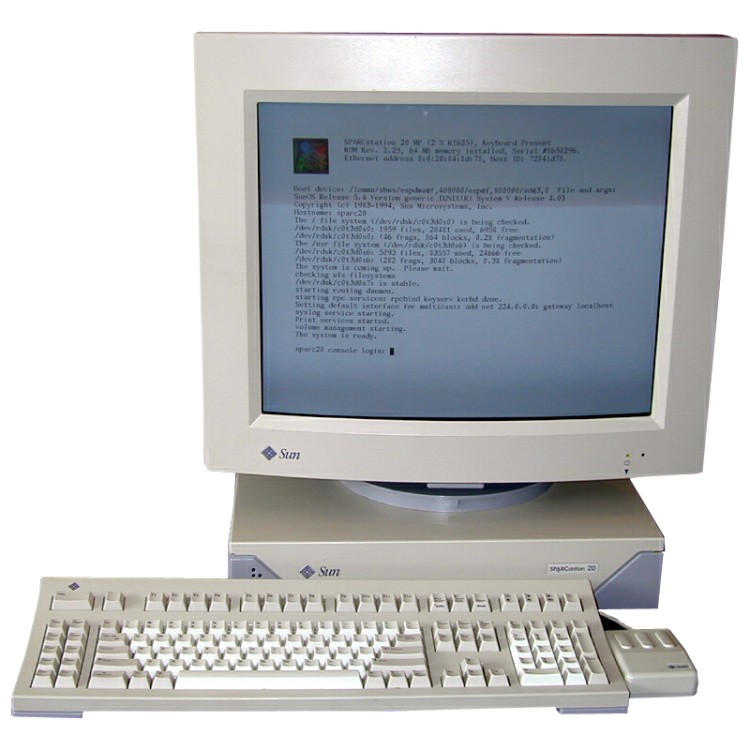
This old Sparcstation I managed to get for free years ago would display everything in "light mode" by default. If you would boot Linux or NetBSD to the console it would be a white background with black text.
It's because majority of us have no real problems to solve, so we do what everyone else is doing in the corporate world and make ourselves useful that we can keep collecting paychecks. Best way to do that is by over-engineering solutions to problems that are already solved.
Or we can replace perfectly functional systems simply because replacing legacy systems with modern solutions has some intrinsic value on its own, even if the modern system brings no additional value.
There are bunch of real problems that could be solved with software, but there's no money in it so why bother? It's better to roleplay technical expert and collect consultation rewards doing nothing.
Distractions are not really my problem, it's mental exhaustion. If anything I think I should probably have more breaks, when I'm at work I just work. I see majority of people procrastinating, reading news, social media or socializing with coworkers to take their mind off work from time to time.
If you can work 8 hours straight with only a lunch break, I don't think you are doing very mentally intensive work.
I have studied and kept detailed logs of my work for years. When I reach 4-5 hours of "real" work (i.e. deep work) I am mentally exhausted and I consider it a good day.
No one expects you to be 8 hours straight in the zone, no one does. And if you can do so, the more power to you, but be careful not to burn yourself out.
I've worked in a previous position that expected 8 hours of billable work for many of the junior devs, who didn't have meetings or documentation. It was crazy.
Sure, with meetings etc not all 8 hours is going to be deep work, but there's usually more in a workday than that. Meetings, mentoring, etc... But my impression of what the OP is saying isn't really looking at it that way, and is saying 8 hours is too large of a block for work in general, not just deep work.
r/linux was recently having some laissez-faire experiment where there was minimal to no moderation for one week. Everyone was like "hey, nobody discovered major vulnerabilities in one week, moderation has no function!"
No moderation on anonymous forums certainly seem to attract the brightest and shiniest individuals together. Cough.
Piketty also did good job in providing proof that the discourse Marx's capital started is still relevant today: wealth keeps concentrating and that will undermine the whole premise of democracy.
“When the rate of return on capital exceeds the rate of growth of output and income, as it did in the nineteenth century and seems quite likely to do again in the twenty-first, capitalism automatically generates arbitrary and unsustainable inequalities that radically undermine the meritocratic values on which democratic societies are based.” ― Thomas Piketty, Capital in the Twenty-First Century
This outcome is probably clear to anyone who has been paying attention, but the power of Piketty's book is in the way it lays out mathematical proof using pile of historical data as evidence.
The response to Piketty's book from ideological opposition have ranged from "So what?" to more valid attempts at asking theoretical questions about the validity of r > g, but nothing exactly that comes close to debunking the core thesis.


In case I sound elitist, I don't think those competent people have any inherent trait that makes them that way, it's more to do with whether you know how to do deep work, it's something you can learn.