the very first assumption of this post is fragile "Although Apple doesn’t make these numbers public, I bet most people search instead of browse through the App Store categories to find the apps they’re looking for"
1. This is really far from certain. actually the reality is that most apps who get massive downloads from the app store got featured or from the top charts when they reach the top 1. I never heard a developer who had massive growth because he was "searched"
2. The App store has been redesigned mostly for visual discovery and not search. Explaining the streams, big stickers, card browsing
If you want to be discovered in massive volume in the app store the only way is to get promoted or top ranked
The other cases are edge cases and frankly do not justify complaining about how such results are displayed.
I'm pretty sure that when it comes to apps linked to a well known brand (e.g. Picasa, Twitter, Flickr) or solve some kind of specific problem (todo, email, finances) do have downloads primarily from search.
Discovery by being promoted or top ranked only works for apps where downloads are impulse-driven, games being the primary example. Searches on the other hand are intent driven, initiated by users that want to get something done. And I don't think developers of such utility apps want massive downloads, they just want to make a profit.
Also your argument about discovery needing top ranking is circular. To get top ranking you first need discovery. This is where iTunes fails its customers - as it focuses on the new and the shinny, creating an environment where apps that build a reputation slowly have no place, which is why most apps in the app store are released in a fire and forget fashion.
Thanks for the comments and interesting conversation. Here is a comment i just posted to the author of the post. I hope it brings some light on the situation.
====================================
i wanted to follow up on your note regarding app booster.
First off App booster is a dialog system between the developer and the user. It includes a among other elements a simple feedback system which is not a review UI. It is a way for users to simply and directly contact the developers. Like thousands of apps we had at the beginning a simple email feedback system, but we realized that all it was creating was poor quality feedback - mostly blank emails. Many developers were in the same situation. So we decided to create our own app specific, mobile feedback system.
The idea behind this feedback system was, unlike the app store, to allow the developer to have a chance to respond before the user posts a bad review. Many times bad reviews are published for the wrong reasons and are wrongly attributed to the developer who has no chance to answer in the app store (eg users complaining of an app performing poorly, when the problem was the wifi connection or poor 3G connection..). We had to create a system that allow the developer to have a chance to answer first. If we were suggesting the user to drop a negative review in the app store, then we would simply kill that possibility.
When a positive feedback is sent, it is mostly likely one that does not need an answer and it felt right to entice the user to visit the app store to publish a review there. Note that unlike other methods you are describing in your post this is not forced to all users by a popup, It is natively integrated in the flow of a user already satisfied in the app. Jumping from there to the app store is not incentivized or rewarded in anyway (your post does not mention those methods used by many apps who will ask for a like on Facebook or pay users to review apps which are clearly manipulative methods). The review comes in context in a full optin way, with no tricks.
When using App booster, Users know they are not submitting a review to the App store and they send "Feedback" to the developer because this is the app messaging system. I am not sure why you would consider it differently and i would suggest an edit to your post. You seem to indicate we may try to confuse user with that approach?
We don't agree with your interpretation this is manipulation. As a matter of fact we believe this is the right thing to do. It just makes things right for the developer and the user. No one is forcing any one and a real dialog can take place. The real problem is that the review system is broken in the app store. It is being gamed, it is being manipulated, but you should look in a different direction: look at services paying or rewarding users creating massive pattern of ratings in a matter of hours.
App booster is an user friendly, developer friendly way to re-establish what the app store has never offered: a direct dialog channel with the user and a smart feedback system to treat efficiently bad and good feedback.
Let me know if you have more questions
PS: We actually showed our system to some people at Apple who actually reacted very positively to the initiative.
It's true that Apple's App Store design encourages users to vent into reviews because it does not provide a straightforward way to contact the developers or raise a support ticket. This is bad and it really needs fixing.
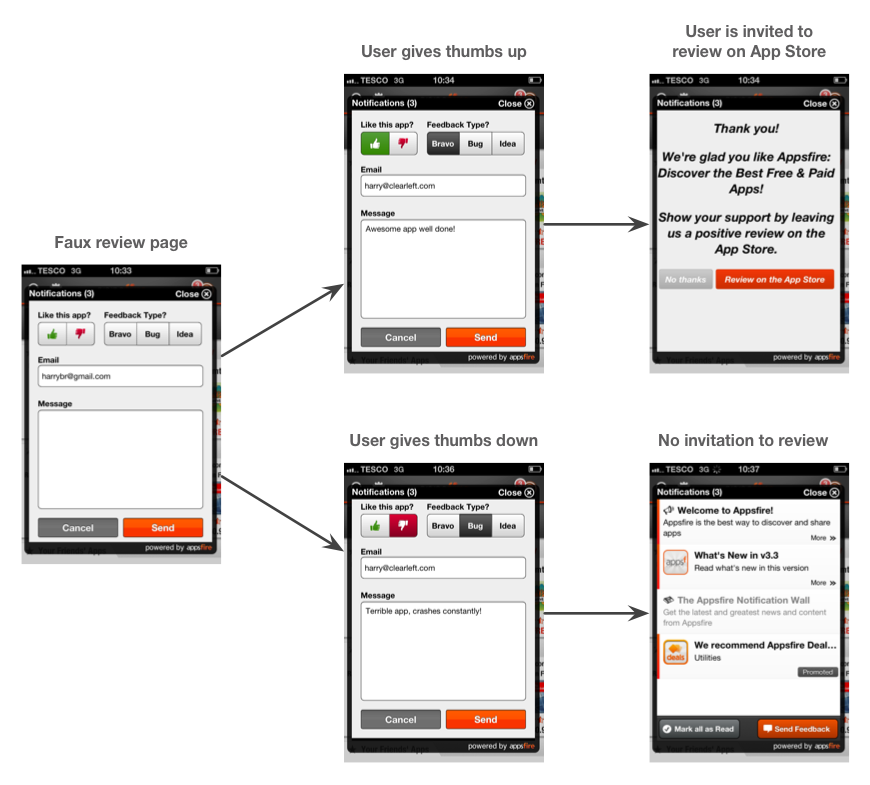
However, your approach is not neutral. Let's just take a look at the logic (diagram from article):
After a user submits positive feedback, they are invited to leave a review. After a user submits negative feedback, they are not invited to do so - only a highly motivated user would then bother to leave the app, find the entry in the App Store and write a review there. What's more, it's hard to say whether some users will even understand the difference between your internal feedback UI and the Apple App Store review UI. i.e. they might think that your feedback form posts into the App Store reviews area.
For the record, the article does not claim "this is evil" (as kgtm stated earlier). It simply states that the appsfire interface fits the definition of a dark pattern. Whether you think it's ethical or not, you have to agree that the UI is somewhat manipulative.
Well, if an app author is going to go the extra mile and write a mechanism to complement apple's deficient review system, you can't really ask them to be neutral while doing so. Think about it for a second, how could they have done it differently? The only viable option is to remove the link to leaving a review after the positive feedback and that's removing functionality(If I found an app useful I want to help the developer by leaving a positive review). I can't really blame anyone for not adding a link to leaving a review after the user has given negative feedback, I definitely wouldn't to it.
Furthermore, I don't use iOS, but if review patterns are similar to those on Android(and I can't really see why they wouldn't be) then I can really see where the app's author is coming from. Most negative reviews I've seen(especially on actually good apps) have been things like "1-star doesn't work!" in a sea of "5-star awesome app!". You can hardly blame a developer for wanting to know how it "doesn't work" instead of just getting a vague review that doesn't explain anything.
Harry calling our approach "Dark pattern" is probably far streched. Appsfire App booster is a dialog system and the feedback system is built to give the developer a chance to answer the user before he s goes public about his review. This is in our mind way better than the current practice in the app store. If you want to look at Dark Patterns consider paid review/ratings systems, incentivized ratings systems many apps have built in, or simply abusive intrusive popups breaking the user experience that will probably lead to unjustified negative reviews in the app store.
One point of note is that you selected "bug" for the category/tag for your feedback. By almost anyone's definition of review vs. bug report there is a big difference and posting a bug report as a review doesn't ensure that the developer would see that info.
I'm not claiming what they're doing is ideal, but I can see a strong argument for not sending bug reports to the app store reviews.


If you want to be discovered in massive volume in the app store the only way is to get promoted or top ranked
The other cases are edge cases and frankly do not justify complaining about how such results are displayed.
Ouriel appsfire.com