I was hoping to see if by "21st-Century" it meant "music theory that is applicable to the way modern music is generally written and interacted with". With details on things like microtonal music, increased focus on rhythmic theory, an increased appreciation for the role that timbre plays in the sound of music, the theoretical frameworks that underpin long standing musical traditions of other cultures and contrasting what makes each musical theory unique as a way of better understanding both western theories of music as well as the breadth of musical expression....
Nope! Just the same old, well beaten, rotting corpse of a horse in the form of a musical theory that entirely exists to prop up schenkerian analysis. The one that that racist, elitist music programs have been teaching since well before the 21st-Century. (The way you can tell is because it includes figured bass, which is totally irrelevant to any discussion that isn't about the harmonic style of 18th century european musicians.)
God forbid I want to, oh I don't know, make music that's similar to the kind that I actually listen to on a regular basis? Better understand its underpinnings and what makes it work in the ways that it does? No. Figured bass.
Somebody ate Adam Neely's video hook line and sinker.
I do agree, but I don't know how many generations will die before we can overturn the ridiculousness of the current approach. Even the book linked has some nice flowcharts of harmonic function, given as a useful tool for analysis and composing. Sadly, the theory fails almost instantly, defeated by the highly experimental niche piece of music called "Hotel California".
However, bringing race and class into it, while true, does not help the argument, as most people you're trying to convince are already fully convinced of the supremacy of the German masters.
I'd much rather all of the resources that are going into autonomous cars was instead going into proper public transit infrastructure. Cars are so hopelessly space and energy inefficient, and I hate driving them. If I could get around by bus, light rail, bike, and all of the wasted city space devoted to parking could be turned into more housing and amenities, that would be great.
I think it would be meaningful to also compare the fatality rates of the time tested and proven forms of public transit to these self driving cars too.
a) even countries known for good transit like Japan still have a ton of cars for various things, and
b) there's no getting around that the money going into self-driving cars vs public transit isn't something that can really be swapped. It's coming from a different place for a different reason.
We absolutely could invest into more trains even with the SDC money flowing anyway, it's not like the SDC money is blocking it. We collectively choose not to do this, and it's not Waymo's fault.
"Let's make car owners more miserable" is a typical sentiment held by young, healthy people who live in dense cities and ride an electric bicycle to work.
Not everyone can do that. Many areas also completely lack the public transit infrastructure needed to support a normal life.
E.g., a couple of days ago, I was shocked to learn just how bad the UK public transport system really is, apparently, outside of major metros (https://news.ycombinator.com/item?id=49445286)
I proposed to let people pay for the services they use.
That is not an attack on redistribution to unhealthy older people living outside of the city.
In the contrary. By reducing the load on the transport infrastructure you make it easier for them to use it.
And for your wish to redistribute: That can easily be done without the city making the use of the land for roads free. You could literally just give subsidies to people who absolutely need cars.
The negative externalities? On net the benefits are enormously positive, which is why every community around the world down to the very poorest, even illiterate societies (ancient civs were mostly illiterate and still built extensive road networks) will start clearing paths to make transport easier. It's an enormous social net benefit, the free, fast, efficient movement of people from one point of their choosing to another.
Just keep it in mind when you are stuck in your 12-lane city streets.
It is a weird position though. Public transport is good for car drivers as it reduces load on the roads. Regardless of that, car drivers loathe people in public transit.
They also always hand wave the last mile problem. Last time this came up some folks were adamant that you could solve public transit and specifically last mile in a city like Dallas.
I welcome the car overlords like Waymo or related companies. I believe this is absolutely a step in the right direction and bringing up the public transit is sort of a “perfect is the enemy of good enough” situation.
Public transit doesn't really go that far, when you talk about the last mile it's pretty limited.
But I do like what you're going with that and maybe we could have public autonomous car infrastructure that we all share. And just one large global team working on awesome autonomous vehicles. That could be little pod type vehicles for one person and bigger ones as needed. Cuz the road system is pretty broad and amazing right now.
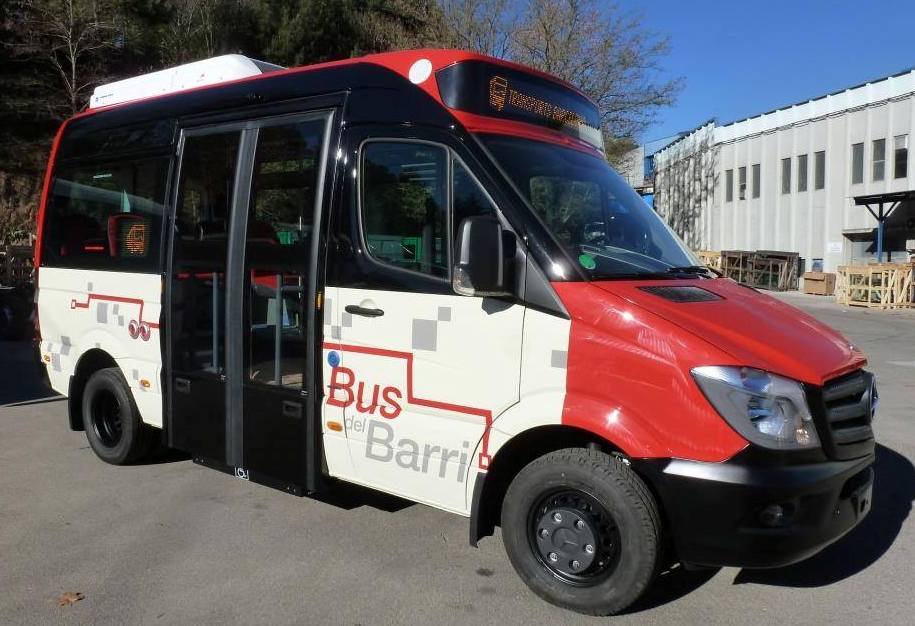
Where is that last mile exactly? In many metropolitan areas, you typically have available a broad selection of trains, subways, trams and/or buses of different sizes that takes you last mile. Some places even have special buses, like the "Neighbourhood Bus" we have here (https://www.barcelona.cat/mobilitat/sites/default/files/bcn-...) for narrow and steep neighborhoods up on mountains.
It's certainly doable, if you wanted to have last mile public transport.
Another consideration that needs to be made before tossing out private transit because "public transit is better" is not all people are able bodied, able, or willing to use public transit.
If it is 2am and you need to get home as a woman, it would be a no brainer to get in an autonomous vehicle while going on public transit is a bad coin flip on being harassed at minimum.
If you are wheelchair bound and the elevator is broken, wheelchair ramp is broken, or someone is already using the wheelchair spot, you just have to wait for luck to change.
If you have sensory difficulties that make public transit uncomfortable, private transit is always the better option.
The list goes on for many reasons and people that having only public transit would harm. The idea we can get rid of or otherwise push out private transit marginalizes everyone who isn't prototypical nor should we hand-wave that they can just rely on runs-on-other-people's-time disabled specific transports to get them into city centers because private transport isn't allowed in.
> not all people are able bodied, able, or willing to use public transit.
Not all people are able bodied, able, or willing to use cars. Cars are killing tens of thousands a year while destroying the environment.
> while going on public transit is a bad coin flip on being harassed at minimum.
While this is going to be city-dependent, I'm a woman who frequently travels along late at night on public transit and I've never had any issues beyond annoying drunk people. You're making this up.
> If you are wheelchair bound and the elevator is broken, wheelchair ramp is broken, or someone is already using the wheelchair spot, you just have to wait for luck to change.
Making sure that public transit is wheelchair-accessible is vitally important, I'm glad we agree on that. How do cars do in that regard? They don't work at all unless you can afford a chauffeur. Your argument here is essentially "public transit is sometimes bad, so it's not worth it to make it better", which is nonsensical.
> only public transit
> private transport isn't allowed in
Ridiculous strawman. Nobody is arguing for the abolition of the private vehicle, just the ways in which we design our cities to prioritize only private vehicles at the expense of everything else. Plenty of people in transit-friendly cities own cars. Replacing a large majority of private car trips would save lives, help the environment, make things more accessible, and make cities more pleasant to be in.
People on wheelchair do drive, often with hands control. I knew a guy who would drive manual, since in our country automatic didn't even exist at the time. All with his hands.
Also as a disabled guy myself, public transport here in sweden is NOT accessible (despite what the swedish propaganda will claim) but even if it were, you're not going to have a stop inside your apartment, and when there's roadworks or ice or whatever and they leave you stranded 1-2km away from where you were supposed to go, having a ramp on the bus isn't going to help you that much.
Also I've witnessed drivers picking up and literally throwing out a woman on a wheelchair because the ramp didn't work. It wasn't her stop, she didn't want to get off, they were simply fed up with trying to get it to work.
Trains and subways, by definition, are not serving you in that "last mile". The "last mile" is where you disembark from the closest rapid/public transport, but you still need to travel to your destination.
You said both "tram" and "neighbourhood" so I'm assuming you aren't in the US. I truly mean no offense, but it's hard to express how spread out even the most metropolitan areas are in the US.
Sure, NYC is one thing. But check out the ~10th largest city, Austin, where Waymo and other autonomous vehicles are (I think) in their largest deployment. Just on a map, or by density numbers, or whatever metric you want.
I'm in Austin, and Waymos rule. I walk most places, bike others, and rarely drive. I very, very rarely get a rideshare (and often get Waymo by way of Uber lottery). Autonomous vehicles exist, are real, and serve an actual need in this very low density city that most people on HN have heard of. I have 3 kids and if I could snap my fingers and swap them for Tesla Robotaxis (Waymos are better and safer!) I would in a second. I would even pay for that to happen.
If you're arguing about some idealistic society, that's one thing. In reality these things are way better than our public transit, and fixing public transit in a place this (not) dense is not as easy as you might think. The last mile is real, and people are coming from every direction and going every other direction and not willing to wait and transfers when these autonomous vehicles already solve the problems door to door so inexpensively.
US cities are spread out due to policies enacted only 50–60 years ago to improve connectivity by car. New policies can (and will) reshape them again in the next couple of decades. For example, building transit creates environments where people's trips are well served by transit.
Not even remotely true. US cities are spread out because they could be, because the landmass is beyond the comprehension of someone if they never left the UK or western Europe. It takes nearly a full day of high-speed driving to cross Texas if you stop for some decent meals. Cities are spread out because, what, you expect a group of farmers out in remote areas to see their options as travel weeks on horse to a single distant city or set up a local community and decide to travel weeks every time they need something?
And that condition was true long before the last 50-60 years -- which, I mean, do you know what year it is? 60 years ago was 1966. Route 66 was famously a thing in the 20s, the modern highway system in the late 50s. Those things connected what already was happening, it didn't create the phenomenon from thin air. Of course cities/communities have tended to spread along the interstate highway corridors -- which tells you how much people value them -- but again, that was happening first. There's old neighborhoods in many older American cities (including my own that were built between 1890 and the 1920s) that look just like suburban ones -- small front and back yards, packed fairly close together -- that predate even widespread adoption of cars. Again, US policy gave the people what they were already desiring, in a more efficient way.
That's what you'd expect from representative government when its functioning. The people that spend the most time talking about a need to "reshape" things are typically taking a more autocratic, I-know-what-you-want-better-than-you-do paternalistic, anti-democratic approach.
Every time you make someone switch modes of transportation to complete their commute, the suffering increases exponentially in my personal experience. I much prefer going door to door and getting the benefit of resting my mind and body.
I live in Switzerland. Public transit goes _everywhere_, even remote villages and mountains. This is by design, such that one can only use public transit to go almost everywhere in the country.
Is public transit always more convenient than the individual car ? No, but you can make the conscious choice of not owning a car, even if you need to raise a family. Switzerland has a high rate of car ownership, because we have a lot of money to spend. But many people, even if they own a car, will sometimes use public transit, because it is convenient, safe and comfortable.
There are places in Switzerland where if you need to take a taxi or an Uber, you will have to wait more than 30 minutes before one gets there. At this point, it is more convenient to take the regional bus that goes every 30 minutes. Even if the public transit frequency is every hour, I can plan my journey to arrive on the correct time (also, public transit is synchronised in the whole country to avoid waiting times).
I can see autonomous rideshares displacing taxi service and such. I think automonous rideshares still need density to be profitable. So if you need to subsidise rideshare to cover the whole country, why not properly invest in public transit?
Good for your country but also your country is quite small. I think a better analog is taking a trip from Zurich to Madrid. You could do it via train but it is probably going to be filled with lots of transfers and take 20 hours or you could take a 2 hour flight.
Fun fact: you can do Zürich Madrid with 3 transfers and 14 hours. The car will take 16 hours. Obviously, nobody is going to do that, and the plane is a better alternative. Your example does not get solved by autonomous cars, I am quite certain nobody is going to do this in a rideshare either.
Most people commute to the nearest city, move within a city, or go see friends in a neighboring city. Yes, US is much bigger, but I am quite certain that most people don't do more than 75km on a daily basis. The US still has plenty of medium and high density, where good public transit would make a lot of sense, but it is seriously lacking. It is a political decision, not a inevitable fact of life that the US has poor transit compared to other countries.
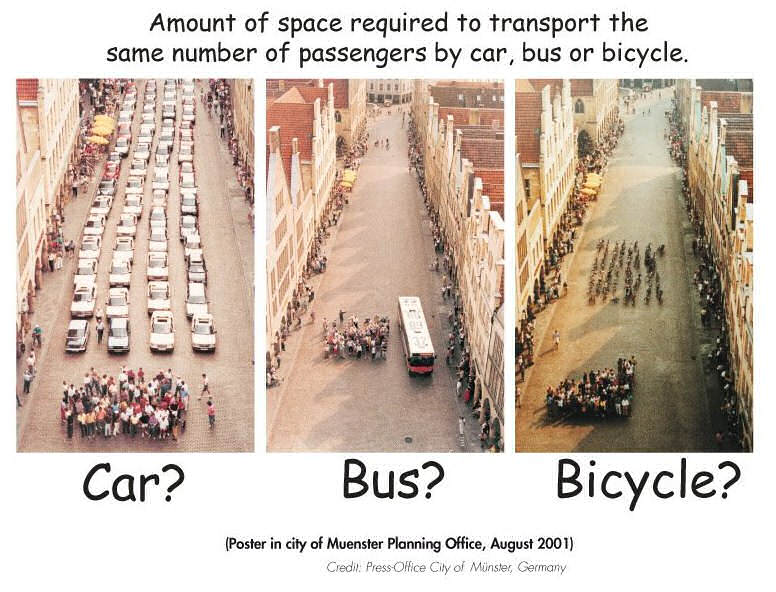
The correct question to answer would be: how do you move people efficiently in a 75km radius? Are there trips that could be solved with a good train, tram or bus? Do you provide streets with bike lanes such that people feel safe riding the bike? What about pedestrians? Are autonomous cars really solving the congestion problem? Most of these cars still need to be parked during the night when demand is lower, exactly like a railyard. However, the space taken by one person in one car is much higher than any other forms of transit.
My point here is: autonomous rideshares may displace taxi services and Uber. But most importantly, good street and city design, which is hard but not impossible, matters much more than solving the autonomous car problem.
I did a poor job with my example. My point is that your example is just a cherry picked anecdote from an extremely small country that has the luxury of a handful of dense cities and a large number of smaller towns that sit on the couple of major roads arteries.
I think you don’t have enough exposure. Yes yes road design great. Bike lanes great. Higher density great. It still does not solve the problem in American. My own cherry-picked example. The DFW metro area is half the land size of your country. A lot of it is already built up and it’s massively sprawling. On a normal commute from any given 5mile radius is going to be highly unpredictable, people are going in every direction. It’s extremely hot in the summer and it rains. Huge change management problem that you will not overcome. At the end of the day it’s hard to make a comparison from a country where a city by land is 2% the size of Dallas.
Last mile is an incredibly challenging problem in the US. It is typically not economically feasible even ignoring the culture change management. Short of rebuilding entire cities and forcing people into high density buildings most of this will not change. Now if you can make really amazing autonomous vehicles that can actually solve most of the last mile problem and introduces the ability for cities to create mass transit that is an interesting solution. Even if use for the full commute those have real potential to eliminate congestion as after all it’s usually some combination of accidents and poor driving. Parking those at night? That is no issue at all.
Here is the thing: the DFW metro area (from Wikipedia) has > 8.3M residents, Switzerland has 9.1M residents. The DFW metro density sits at 339.9/km2 (I took the conurbation number which has a lower number), and Switzerland sits at 207/km2.
So, in your example, Switzerland has less density than the metro area you mentionned, and yet it has much better public transit. Half of swiss population lives in tiny villages with no more than 5'000 residents. The last mile problem is also a problem for Switzerland. And yes, our summers are also hot, and winters even worse with lots of rain and snow. Not counting the mountainnous terrain, for example the city of Lausanne has difference in elevation of 400m, which is challenging to do by bike.
My point here is: you don't need a lot of density to create transit. It does not depend on the absolute size of the country. Yes, changing a city is hard (especially politically and culturally). But you need repave streets every 20 to 30 years anyways. You could make the city better by just changing how you decide to allocate the space every time you need to redesign a street.
These become such silly arguments. Why are you arguing against autonomous vehicles in America? Your examples on a base general case are not applicable and while I agree there are areas where things can be improved, for most American cities it does not make sense. Most all European examples including Switzerland are not applicable. Yes yes you have 5k population towns but they are all connected to very few arteries and in probably most cases it’s a single major road and commuter rail. Your summers are much more mild and winters (in the plains) around slightly warmer at the extremes. Doesn’t something like 60% of the Swiss population live in flats? You live in a small town probably in a flat and you take a train a few miles away to another larger city that is also relatively small and compact and you have much nicer weather if you walk around. These are such silly comparisons. What works in your geography because it’s small, highly concentrated in apartments, lack of sprawl, usually only one major road, more mild weather, makes it a lot easier to solve.
Let’s say you have redesigned a road in DFW, the question is so what? What does that accomplish? There are definitely pockets of improvement to be had but largely nobody is commuting via bicycle in DFW unless you have an extremely short commute. Those few miles of road won’t help a bus and again highlighting it’s a distribution last/first mile problem. The Swiss and most of Europe just by historical design, lower growth and cultural differences don’t have to solve for last and first mile (keep in mind a last mile could easily be 5 miles). There is no solution at scale short of rebuilding and designing an entire city. Autonomous vehicles are a nice solution here. They may support first and last mile allowing cities to implement concentrated transit options but they will also just get some number of cars off the road and create safer and better traffic.
I am happy Switzerland has a natural fit for commuter rail. It’s simply not happening in most of America so we should not let perfect be the enemy of good enough.
But it is. In America if you tell someone they are going to need to walk home for 15 minutes they will in the base case opt to take their car.
This type of convo has come up in a number of different ways on HN and folks just hand wave away the problems in the US all the time. Americans don’t want to walk outside for an extended amount of time and the last mile(s) problem is quite hard.
In most US cities you cannot economically solve the last mile problem efficiently with public transit and similarly most folks will already opt to take their car even if the public transit is great. You will likely be left with at least a few miles for someone to get home. So now are people transferring to other modes of transport because they are not taking a bicycle?
This is where I've always assumed things were going. People talk about one day owning a self-driving car but I look forward to the promise of not owning a car, never needing to buy, maintain, register, insure, or drive one. Not having to buy into a depreciating compromise, do I prioritize economy or seating or cargo or...? Gas, hybrid, electric? Not having to hunt or pay for parking.
Private cars are costly and spend most of their time just taking up space.
We'll see if it ever works out that way but a boy can dream.
Rental scooters/bikes cover last mile service very well in my experience. I use transit a great deal more than I would if I had to walk so much on either end of the trip.
Americans would rather die than give up their air conditioned bubbles on wheels. I've wondered why someone hasn't tried manufacturing an enclosed go kart with AC and enough trunk space for a few groceries.
> I've wondered why someone hasn't tried manufacturing an enclosed go kart with AC and enough trunk space for a few groceries.
I see these all the time here in the Netherlands. Very small cars. Some on the road and even smaller ones people drive on the bike paths. Small motorized vehicles, ebikes and scooters share the paths with regular bikes which works because they have usually at least two lanes, so they are more like tiny roads. Very handy.
Regulation kills the value proposition. You are basically describing a "neighborhood electric vehicle", but US law limits them to 25 mph, and it is not legal to drive them on many arterials, so they are only really useful inside communities which were designed for them.
They really should just open up letting you have a small vehicle everywhere in the country. Sometimes you visit some city or little rural area where they let you drive golf carts or atvs or snow mobiles on the roads, grocery store lots are more full of those instead of bigger vehicles as a result, and the sky doesn't seem to fall down either.
I get it if you live in a dense metro. A car is not worth it in NYC, SF, etc. Other than that it's pretty abnormal for people not to want a car. It's usually some weird anxiety about driving. Not to mention - heaven forbid - you have a family.
They are very popular in china, such as the Wuling ev. In America, they are afraid of them because they are small. They want big cars to have a large crumple area in a crash.
Because most people feel uncomfortable being in the tiny vehicle that sits below the bumber of all the trucks and suvs that surround them. It's one of those things that doesn't work until a large percentage of other people are doing it. Very few want to put themselves in more danger for principled reasons.
And cars started getting bigger because, it was a way to legally classify them as trucks thus saving money for the manufacturer. And then everyone had to follow just to feel safe
And of course this mostly only happened and is far more noticeable in the us than elsewhere when measured in car size and people were convinced to buy the larger cars aka turned SUVs and pick up trucks by marketing. This started to happen in the 2000s
I'm in a 200 inhabitants village in eastern Europe, we have 3 bus stops in the village (so at most you're 10min away from a stop), the bus goes to the closest city every hour from 4:30 to 22:30 except on Sunday (every two hours from 6 to 21), from there you can take a train to every major city in the country, my neighbor is a 76 year old widow who goes to the city by bus regularly and who bikes around a lot. Half of the kids go to school via this bus, many people go to work with it. It's free for kids and retired people too.
When public transportation is designed properly it works fine for the extreme vast majority of people, and taking a taxi for the last mile if you're disabled, obese, lazy, etc. will cost you less than owning and maintaining a car.
I think you're coping, like most car owners, we bought the propaganda of freedom &Co and now we're all collectively stuck in this dumb system in which every household need to own two 2500kg hunks of steel and plastic to transport 70kg of meat 1% of the time and use public space the other 99%
>I think you're coping, like most car owners, we bought the propaganda of freedom &Co
When the bus (in your example) runs on a hourly schedule, while your car is always there when you spontaneously need it, then that freedom is real and not just propaganda.
I did this type of commute before where I had to catch the bus to work, which was also once every hour, and the anxiety during my early morning routine to not miss the bus was crazy since missing it meant one more hour of wait, compared to the freedom of jumping in my car without a fixed schedule while also saving 1h/day of time compared to the public transit, the difference was night and day, not propaganda.
Now if I had a train/subway to work, where I could sit down, and it ran every 15 minutes or less, then yeah, fuck driving and public transport all the way, but nobody sits in traffic for fun, but because of all options for their commute, driving is the better option.
Then let's keep on fucking the planet, and let's keep on moving 70kg of meat over 30km per day on average with 2500kg of steal, 400kg of battery, etc. super efficient and sustainable!
YES, unless you wanna build me public transport from your tax money, let's! If you want people to stop fucking the planet with driving, then you need to stop fucking their lives with hellish public transport commutes and improve it till it's bearable.
I have only one life on this planet, and it's much shorter than the planet's life, therefore I need to make it a good and comfortable one while it lasts not sacrifice it for nothing, while China and India keep lighting the planet on fire and my boss is chauffeured in luxury cars and has 3 vacation homes. You need to (have the wealthy) lead by example and sacrifice themselves too before you ask the same from the working class!
If you wanna save the planet, then first talk to China and India, talk to politicians and corporate billionaires with private jets and yachts making a killing from forcing everyone into office 5 days/week and dodging taxes so that cities lack funds for infrastructure, not to the working class keeping the world running and feeding their families.
>we bought the propaganda of freedom &Co and now we're all collectively stuck in this dumb system in which every household need to own two 2500kg hunks of steel and plastic to transport 70kg of meat 1% of the time and use public space the other 99%
Didn't you just say you can get around fine on the bus? Can't you just get a car if it suits you?
For me personally it's nice to have a car. It would certainly be tough if I had less resources and public transit would be more appreciated.
Seattle, late middle age. Kid just started high school. My wife has a large e-bike with a passenger seat, but replaced it with a cargo basket a couple years ago after the kiddo outgrew it.
I didn't say that scooters were a solution for everyone, you may note. I don't think there ought to be one solution for everyone, but given the option of micromobility, I really have no use for autonomous vehicles.
The famously small conurbations and the reality that Finns and Norwegians only are able to bike part of the year. They have cars and public transit for the rest.
I'd add that these discussions tend to handwave the reality of safety when you're on an open platform movie at high speeds, the reality that not all people are physically able, and a lot of others issues that the vocal "cars are the devil" folks don't engage seriously with.
It's getting really old, and it increasingly feels like trying to reason with the "kill all pitbulls" crowd.
> Finns and Norwegians only are able to bike part of the year.
They very much bike all year round, even in the north where it regularly gets to -20C(-4F) in winter. Biking in snowy sub-freezing weather is really not a big deal as long as you maintain the bike paths as well as the streets.
Source: have lived there, everyone I knew had a bike they regularly used. The only time I can recall where people I knew who usually commuted by bike didn't do so was during an unusually heavy snowstorm. They instead had to walk about half a kilometer to/from where the city had managed to plow the streets and take a taxi. That was decades ago.
> Source: have lived there, everyone I knew had a bike they regularly used.
I don't live in Finway or Norway. It would be nice to be in a country that accepted a more pescetarian / fish-based diet. It might help with the able-bodied reasoning given elsewhere for car driving.
But I live in the US. Here in the US, the loudest advocates we have for biking are groups like Critical Mass. Up in Chicago they have a winter biking campaign. But we know how Critical Mass is perceived by people on the fence about more biking investment. It's a radical group. So discussion digresses into sidewalk safety issues and identity politics. And yes, sidewalk safety impacts people, falls are dangerous for many populations. But all that media bandwidth means simple messages of celebrating biking and transit get lost. There's only limited time on the news.
This isn't an isolated issue. I honestly think that's by design. At this point, in 2026, it's not an accident.
So you have people like me, jobless pervert civil libertarian hipster techbros being the group advocating for more biking. What do you think is going to happen US?
Waymo will be the same thing.
It will be turned into a drama show about saving people feom drunk driving accidents, a very good thing. But then there will be pushback about it encouraging more drinking among the population and increasing rates of domestic abuse. A very horrible and tragic thing.
And some of us will be going to a food pantry wondering why it can't be a more bike oriented endeavor and knowing the truth in our hearts. The US wants drama, even after Trump is gone. And that drama takes focus from just rolling out programs to encourage love of public transit and biking. Media saturation matters. And I don't believe anymore.
So, I'm sorry, Chicago or up north doesn't seem like a great choice personally. It's not healthy for me to dream about up families up there. I'll be biking out west.
Scandanavians have been getting around without cars for millenia. Nobody had even heard of a car until just over a century ago.
Car dependent infrastructure is definitely not helpful for the physically disabled, as well as those too young, too old, and too poor to drive a car. This and a lot of other issues that the vocal and active "cars aren't the devil" crowd don't engage seriously with.
It's getting really old, and increasingly feels like trying to reason with the "Pitbulls make great family dogs" crowd.
Hospitals at the dawn of the 19th century in Europe were generally places only poor people in desperate situations went to give birth because they were hives of disease transmission.
The notion that doctors should wash their hands between treating one patient and the next was met with ridicule. Doctors were insulted by the suggestion that their hands might be unclean, so mortality rates for childbirth in hospitals were horrendous. The idea of handwashing emerged and died many times before it finally caught on, and then only at the behest of vigorous campaigning over a generation.
There is a long list of hidden costs and negative externalities associated with car dependent sprawl as well, they are well studied, but nobody want to hear that their hands are unclean. This idea one should be washing their hands a dozens times per shift is patently absurd. Physicians would be wasting hours a day just washing their hands! How would we be able to treat all these patients?
I think you need to re-read the parent comment, specifically this part:
> I'd much rather all of the resources that are going into autonomous cars was instead going into proper public transit infrastructure.
You're almost certainly an American, and you probably have no idea what public transit is like in countries that have been investing in it for decades instead of focusing 95% of their resources on infrastructure for cars.
> I'd much rather all of the resources that are going into autonomous cars was instead going into proper public transit infrastructure.
Solving the last mile problem also helps solve the public transit problem.
The issue in the US is that the current population configuration does not have single population points connecting to single employment points like back in the days of the mills or the factories. As such, public transit becomes difficult.
For example, the train in Southern California is hampered by the fact that you need huge parking lots and cars at the transit stops. If you can take an autonomous vehicle at either end, that evaporates and a LOT more people can now make use of the train effectively.
Autonomous cars are pretty space and energy efficient if they act as public transportation. Cars spend something like 95% of their life parked. If AVs replace personal ownership, that's a HUGE reduction in the number of cars in existence. The future looks like a lot less parking lots and 8 lane suburban stroads.
Source? You can have many buses using a single BRT lane which is much cheaper to build and maintain than the number of lanes you would need to move the same number of people in private vehicles. Even more so once you start building grade-separated highways and their off ramps.
The mass of unneeded cars will be at the periphery. The equivalent of taxi stands will have needed cars within reasonable distance.
Back in the PRT days we simply planned to store 1-2 vehicles in-station waiting for walk-ups, and if a drop-off comes in they just push out the waiting vehicles and they circle back. The efficiency remains crazy supportive of that model vs empty buses or trains.
If you live in the US, it's not worse. If you live anywhere else in the (developed) world, it is worse.
My hope is that the bottom-of-the-barrel US approach isn't shoved down the throats of everyone else just when we're finally managing to rebuild cities for people, not for cars.
It does. About the same amount of money was spent in funding for Waymo as funding SFMTA over the period Waymo has existed. So in SF we are putting in as much money on public transit as Alphabet et al. is on Waymo and we both have the results we have.
We can have both. The resources aren't coming from the same bucket. Public transportation must be built by the local government, and is subject to that local government's ability to execute. In contrast, Self driving cars are largely siphoning resources from for-profit companies.
I live in the west side of San Francisco, and we may get a subway station by 2050 if we're exceptionally lucky. I'd rather have self-driving cars this decade, please.
To my knowledge there are only a handful of public transit systems in the world that operate at a profit, let alone that operate at enough of a profit to recover construction costs. As in, maybe 5 if you squint really hard. Who do you expect to fund new ones if not the government?
Regional or state is better than local government. Local governments would struggle to raise the required funds for the costs of modern transit and would have a mandate to really support transit within their municipal borders vs a regional solution that is agnostic to the byzantine municipal borders.
>If I could get around by bus, light rail, bike, and all of the wasted city space devoted to parking could be turned into more housing and amenities, that would be great.
I guess it depends on where we're talking about. The majority of the US is not inside a city. So just diverting all resources into public transportation is only serving the metros.
There is a bit of a definitional problem, with people living in suburbs identifying as rural, as do folks in exurbs. I don't think they're considered rural, and they're concentrated enough that well-designed public transit could serve them quite well. A decent public transit system means that families in sub/exurbs can go from 2 cars to 1 car without a major drop in quality of life, but they'd save $5k - $10k per year.
UN urbanization rate is based on the national definition.
The U.S. definition of urban area is based on population (and has been changed recently):
  Under the old criteria, an urbanized area needed to have at least 50,000 residents. An urban cluster was defined as having at least 2,500 people, a threshold that had been around since 1910. Under this definition, almost 81 percent of the U.S. was urban and 19 percent was rural over the past decade.

  Under the new definition, hammered out after the 2020 census, the minimum population required for an area to be considered urban doubled to 5,000 people. Originally, the Census Bureau proposed raising the threshold to 10,000 people but pulled back amid opposition. The new criteria for urban areas shift the urban-rural ratio slightly, to 79.6 percent and 20.4 percent, respectively.
Its not simply population. A vast majority of the area of the US is not in a metro.
You can say “well people need transportation , not land.” And that’s true. But what’s not necessarily true is that we want to cram more people into the cities as opposed to supporting a broader distribution of the population. We absolutely want the latter in terms of housing prices.
Google says annual public transport spend is ~£300bn. If you put all the self driving resources into it it wouldn't make a huge difference. Waymo like vehicles may also help with the last mile issues, giving disabled access to pedestrianised areas and the like.
The problem with transit systems is that they aren't designed for competition. They're costly to make, have few builder companies to choose from (who all know the game very well and go over budget as a tactic), and extremely difficult to overhaul/retrofit when more efficient tech becomes available.
They're great for short distance travel in densely populated areas, but outside of that I doubt they'd hold up in long-term cost and efficiency vs autonomous electric cars for long.
As for parking, a fully autonomous car service would allow a car to come to you and pick you up. So it wouldn't need to park near where you are.
Small self-driving busses would do exactly what you want. The cost of increasing bus service is overwhelmingly the cost of bus drivers. If the busses could drive themselves, cities could afford to deploy a lot more busses, especially smaller busses, running much more often.
As for light rail, in the US, light rail projects can typically cost hundreds of millions of dollars per mile. The NYC 2nd Avenue subway expansion cost billions of dollars per mile.
And, if you want people to stop wasting city space on parking, self-driving taxis are exactly the right solution.
If buses are autonomous, it no longer makes sense to have arbitrary routes that people need to wait at a bus stop for. They can wait in parking lots, charging their batteries, until they are summoned, and give people door-to-door transportation.
It sounds like an autonomous taxi, but not necessarily. A taxi usually has only one rider, whereas a bus would have more seats, and potentially pick up and drop off other riders that are more-or-less on the way. This is Via's Microtransit[1] model, but without the cost of a human driver, it becomes much more cost-effective to deploy at large scale.
That model doesn't really work with high demand I wouldn't think. The thing with the fixed route case is you no longer have to serve the many edge cases, you force people to solve it themselves and maximize the service you can offer over a more collectively beneficial routing.
In principle, but there are hard physical challenges such as the lack of space efficiency between a typical four occupant sized vehicle and a bus that holds some 10 or 20 fold more people on maybe only double the road footprint. Time to seek out your paired ridemates is something to consider, it melts away as you pack more people into the same vehicle and increases both in time as well as space as you start introducing more lower capacity vehicles.
You're not comparing against real-world fixed-route bus routes.
In the real world, most bus routes run nearly empty if not completely empty most of the time, belching diesel smoke and paying a driver, in order to ensure that service is provided to remote locations and that service is made available on a regular schedule. In cities, utilization is usually higher, although you see the same pattern off-peak.
In suburban and rural environments, the footprint is nearly irrelevant, but the lack of riders means that early attempts would start with designs that prioritize battery capacity and range over the sheer number of seats. In urban environments, the final mix of buses will look closer to a combination of mid-size buses for door-to-door and full-size buses for trips that are door-to-door but in practice are no different from fixed-routes due to the sheer number of people who take the current routes at rush hour.
> And, if you want people to stop wasting city space on parking, self-driving taxis are exactly the right solution.
Self driving taxis have to be parked (or cruise around continuously), I guess, and that parking better be close cause ain't no one waiting for a self driving car parked 30 minutes away to get moving.
AVs and public transportation are not comparable. The cumulative lifetime investment in Waymo would not fund even half a year of capital expenses for the New York MTA, for example.
I'm not sure that's a fair comparison. The most expensive part of self driving cars is building the roads and highways. Would make more sense to compare Waymo to the operating expenses of PT, hiring the drivers and maintaining the trains.
Building roads for buses are _few orders of magnitude more_ expensive than roads for cars only.
Unfortunately we still have trucking, but it's starting to feel we should build separate roads for them and for special cases only allow multi-axle delivery trucks on normal roads.
We could even build these special purpose, heavy duty roads out of something stronger than asphalt, like metal. Then once we have these sturdy new metal roads for trucks, we can raise the weight limit to allow them to carry heavier loads. And since there’s no little cars getting in the way, we could even group together multiple trucks going in the same direction for better logistical efficiency.
You are suggesting that we should attribute a fraction of the costs of our road building and/or maintenance under autonomous vehicle development? If so, what fraction are you proposing?
No I'm not suggesting that. I'm suggesting that if the proposal was to spend less on self driving and more on public transport, we should be looking at the running costs of PT. Rather than comparing Waymo to digging tunnels or laying tracks, considering we didn't factor road building in the Waymo costs.
I see. But Waymo investments are also vanishingly small compared to PT OpEx. If you for some reason could tap all of the Waymo money, operations and R&D and all of the rest of it, you could fund WMATA and that's it. Americans spend 100x more just on motor fuels than Waymo spends on itself. If you wanted to raise a similar amount of money you would need a mere 5¢ incremental gas tax. Private Americans furthermore spend $1 trillion every year just replacing and fixing their cars. You could double the public transit subsidy across the nation with a 5% car tax.
Roads are used by everyone. Transit right-of-ways are limited to use by transit and are extremely underutilized. In many cases, it would be better to turn those in to bike and/or AV lanes.
>all of the resources that are going into autonomous cars was instead going into proper public transit infrastructure.
They need not be separated. This is the entire point of the Cybercab and the Cybervan: Get self-driving cars, vans, etc. with the one job of moving people around. They only park to recharge or repair.
Where do all those cars needed during peak demand go? They're going to be parked somewhere and it's not going to be in the middle of nowhere, because that's an awful customer experience.
Do you realize the order of magnitude in difference?
If we end up having as many self driving cars as taxis, they can just terminate Waymo tomorrow, what's the point in investing tens of billions? The goal is to replace many or most of the cars on the road.
The self-modifying executable that can modify itself on disk is kinda horrifying to me. In that kind of "ok yes, you have proven you can, but I really think you shouldn't" kind of way.
Incredibly impressive on a conceptual level though. If someone proposed doing this while having the executable only grab a read-only reference to itself, I think that would be a legitimately solid idea.
I think I can tell just how good a design this is by the fact that the moment I interacted with the demo it just felt right. To the extent that I had to focus harder to really recognize that it was doing exactly as described.
Had to reread this a few times to properly parse what the hypothetical was.
My first read was "if you could redo your life from age 17 what would you do". To which "figure out how to make an LLM" would be an insane answer.
I think his advice here is maybe... a year or two too late to be good advice. I can't foresee the job market for machine learning experts being better than it is now in 5-6 years time when said hypothetical 17 year old would be most ready to start career hunting. Either the bubble is gonna pop and the market will be flooded with laid off AI talent.
Even if I'm wrong about there being a bubble at all, I still think that in 5 years time the tech will just have matured to the point of diminishing returns on refining existing architectures. Plateauing until some PHD comes up with something as ground breaking as attention.
I feel like (as is usual with nontechnical reporting on cutting edge science) this article isn't doing a great job at communicating the underlying tech well here. Had to independently look up some descriptions of what super absorption is, and what actually makes it a quantum effect.
Sounds like the idea is, if you've got a bunch of light emitters spaced far closer to each other than the wavelength of light they are emitting, the light output becomes quadratic on the number of emitters. as opposed to linear on the number of emitters in the standard case. And the reverse becomes true as well.
Based on that, I'm pessimistic on the potential of this, as it sounds like charging requires a conversion from electricity to light, and then discharging would also be a conversion from light back to electricity, and we don't exactly have the most lossless processes for that conversion.
Maybe useful in certain kinds of optics or laser work though, where directly dumping the stored energy as light would be desired?
My reading between the lines of the article is that the application would likely be in quantum computing circuits. Where it can be tricky to deliver and store power because everything is supercomputing icebergs.
But I agree, this article is trash. This is simply very bad journalism.
My gut instinct was that operations like sin, cos, tan, etc, were the kind that would get aggressively inlined by any modern compiler, and then after inlining the redundant conversions between radian/turns would be canceled out by optimization passes.
Of course, gut instinct can be wrong, so I checked in godbolt and was surprised to find out that even if I try to force lto, it still doesn't get inlined and remains a call.
I can only hope that the hard github dependency can be chalked up to just "this was the easiest way to get this out the door". Its not a good solution in the long term, (single point of failure, github is increasingly unreliable and disliked, what about people already on a different forge or repository source) but it does solve at least a few problems that would otherwise be thorny (minimum bar for submission, outsourcing identity and spam management to github, etc.)
And since the bar for validation is expressly stated to be rather weak, I guess this would be best conceptualized as a specialized search engine that can weed out the <80th percentile of mediocre formalized proofs, with a target audience of professional mathematicians who have the ability to make determinations on the final 20% themselves.
Maybe also something I'd wanna skim over at some point, as a non-mathmatician who just thinks lean is neat. Its not useful to me but its fun to learn about.
I think 14 exists as a test case for having a larger search space that needs to be efficiently ignored. Its not difficult solution wise, but if it is particularly slow that means you're doing a bad job at pruning potential steps. Making sure you're doing good early pruning of the empty chambers.
Yeah, that was kinda what I figured too, maybe something about the "pinwheel" shape makes the pruning harder (since beyond each bottleneck there's a large amount of useless search space.)
Kinda tempted to go play with it now and see if it becomes more obvious...
While impressive that the optimal can be proven, I feel like the example puzzles here aren't ones that are particularly hard to find solutions for (when move count doesnt matter). I'd be interested to see at least one example that has a lot of tricky dead states that would act as traps.
Imagine providing AI with ability to poke around a large bank of gridbased game problem instances. Ask it to solve them and learn from them and then generate new problem instances.


Nope! Just the same old, well beaten, rotting corpse of a horse in the form of a musical theory that entirely exists to prop up schenkerian analysis. The one that that racist, elitist music programs have been teaching since well before the 21st-Century. (The way you can tell is because it includes figured bass, which is totally irrelevant to any discussion that isn't about the harmonic style of 18th century european musicians.)
God forbid I want to, oh I don't know, make music that's similar to the kind that I actually listen to on a regular basis? Better understand its underpinnings and what makes it work in the ways that it does? No. Figured bass.
reply